Published Jul 2026
Speeding & Adaptive Speeding Alerts
Speeding alerts warn you the moment a vehicle drives too fast, so you can curb risky driving before it turns into an accident or a fine. AVLView offers two templates: Overspeeding against a fixed limit, and Adaptive Speeding, which compares each vehicle to the road's posted limit.
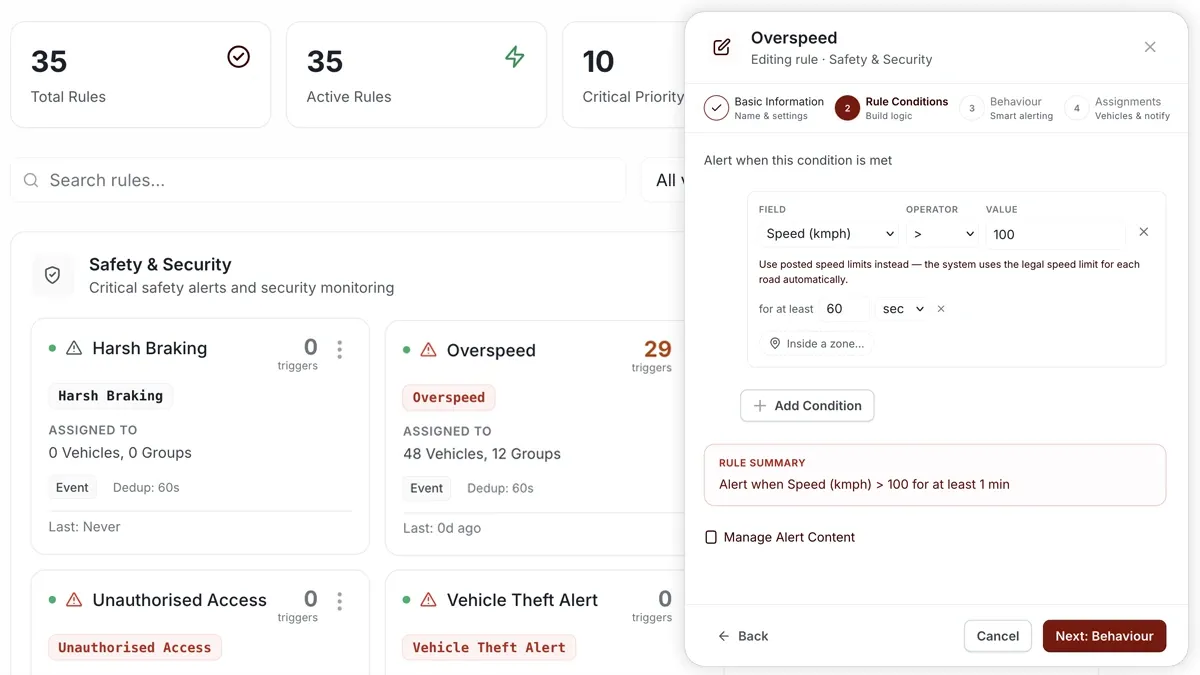
How to set it up
- Go to Alerts > Rules and click Create rule.
- Pick the Overspeeding or Adaptive Speeding template (or choose Start from scratch).
- Adjust the condition: for Overspeeding set the fixed limit (default 120 km/h); for Adaptive, enable use posted limit and set a tolerance.
- Choose which vehicles or groups the rule applies to.
- Set a schedule — Always, Business Hours, Outside Business Hours or Custom.
- Pick the notification channels — In-App, Push, Email or SMS.
- Click Save. When the rule triggers, the alert lands in the Alerts Inbox and notifications go out.
What you can set
- Condition — a fixed speed limit (Overspeeding, default 120 km/h) or posted-limit-aware matching (Adaptive Speeding).
- Tolerance — for Adaptive, how far over the posted limit is allowed, as an absolute km/h or a percentage.
- Fallback limit — the limit Adaptive uses where no posted limit is known.
- Scope — the vehicles or groups covered.
- Schedule — Always, Business Hours, Outside Business Hours or Custom.
- Notifications — In-App, Push, Email or SMS.
- Behaviour settings — fine-tune to cut down on repeated or noisy alerts.
Frequently asked questions
What is the difference between Overspeeding and Adaptive Speeding?
Overspeeding is an EVENT alert that fires when speed exceeds a single fixed limit you set. Adaptive Speeding compares each vehicle against the road's posted limit, with a tolerance and a fallback limit — so it flags speeding relative to where the vehicle actually is.
Why does Adaptive Speeding need a fallback limit?
Posted limits aren't available everywhere. The fallback limit is applied on stretches of road where no posted limit is known, so the rule keeps working end to end.
Related
Next
Harsh Driving: Braking, Acceleration & Cornering
Flag harsh braking, harsh acceleration and harsh cornering with rule-based driver-safety alerts that feed your driver scorecard.
Learn more about this feature
Explore featureMore in Alerts & Reminders
Didn't find what you needed?Contact support