Types of GPS Tracking Devices: Hardwired, OBD, Battery & CAN — Which Fits Your Fleet?

What You'll Learn
Hardwired, OBD plug-in, battery asset trackers or full CAN telematics — here's how to match each GPS tracker type to each vehicle in your fleet.
Best for:
Logistics & Delivery professionals and fleet managers
GPS tracking devices come in four main types: hardwired trackers installed into the vehicle's wiring, OBD plug-and-play trackers that snap into the diagnostics port, battery-powered asset trackers that need no vehicle power at all, and CAN-bus telematics units that read the vehicle's full engine and fuel data.
Each type answers a different job, at a different price, with different trade-offs in install effort, data depth and tamper resistance. Choose per vehicle — not per catalogue — and the same budget buys a far more capable fleet.
This guide covers all four types, an honest comparison table, and a decision matrix by fleet type. (New to how the tracking itself works? Start with our plain-language guide to how GPS vehicle tracking works, then come back.)
The Four Types of GPS Tracking Devices
1. Hardwired GPS Trackers
The workhorse of commercial fleets. A hardwired tracker connects permanently to the vehicle's power and ignition circuits, usually hidden behind the dashboard.
Strengths: Always powered, so it never needs charging or attention. Detects ignition on/off for accurate trip logging. Installed covertly, it's the hardest type for a driver to find or defeat — and with an internal backup battery it keeps reporting even if someone cuts its power (we covered why that matters in how drivers cheat GPS trackers).
Trade-offs: Needs a professional installation (30–60 minutes per vehicle), and moving it to another vehicle means another install.
Best for: Any vehicle you own long-term — trucks, vans, buses, taxis. If the vehicle is the business, hardwire it.
2. OBD Plug-and-Play Trackers
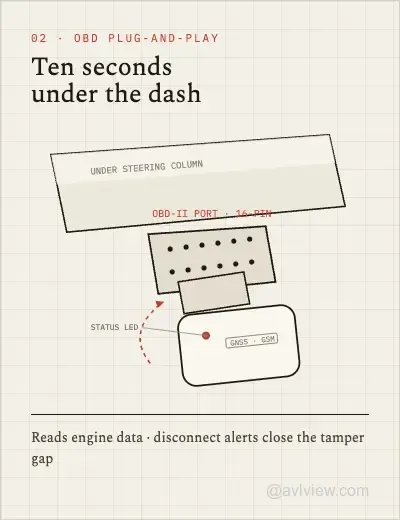
Every car and light vehicle built since the early 2000s has an OBD-II diagnostics port, usually under the steering column. An OBD tracker plugs straight into it — installation takes ten seconds.
Strengths: Zero installation cost, instant deployment, and because the OBD port carries engine data, many OBD trackers read diagnostics, odometer and fuel data too. Perfect when vehicles join and leave the fleet often.
Trade-offs: It's visible and unpluggable — by you, but also by a driver. Disconnect alerts close most of that gap, but for high-risk routes hardwired stays safer. Heavy trucks may need an adapter for their different diagnostic connectors.
Best for: Leased and rented vehicles, sales and service cars, pilot projects, and any fleet that needs tracking rolled out this week rather than this quarter.
3. Battery-Powered Asset Trackers
No wiring, no vehicle power — a sealed, often waterproof unit with its own battery lasting from weeks to several years depending on how often it reports.
Strengths: Attach it to anything: trailers, containers, generators, compressors, skips, even shipment pallets. Magnetic mounts make deployment instant. Rugged IP67-rated housings shrug off weather and washdowns.
Trade-offs: To preserve battery, these devices report sparsely — a few times a day in standby, more often when moving. They tell you where an asset is, not how it's being driven. No live second-by-second tracking.
Best for: Non-powered assets and theft recovery: trailers between hauls, equipment on remote sites, anything that sits in a yard and occasionally disappears.
4. CAN-Bus Telematics Units
The top tier: a hardwired unit that also connects to the vehicle's CAN bus — its internal data network — and reads what the vehicle knows about itself: exact fuel level, RPM, odometer, fault codes, temperatures, seat-belt and door status.
Strengths: This is the hardware that unlocks real fuel monitoring, driver behaviour scoring and predictive maintenance. If you've read our GPS tracking vs telematics comparison — this is the device that turns a tracking platform into a telematics platform.
Trade-offs: Highest hardware cost of the four and the most involved installation. Overkill for a vehicle whose only question is "where is it?"
Best for: Fuel-heavy vehicles, long-haul trucks, buses, refrigerated transport — anywhere the vehicle's own data pays for the device within months.
All Four Types Compared
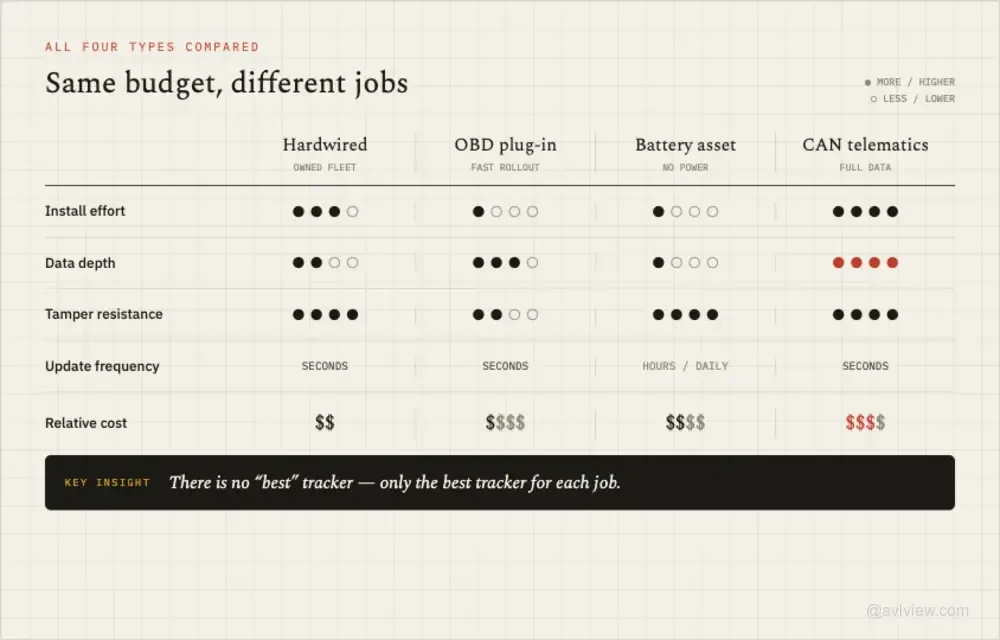
| Hardwired | OBD plug-in | Battery asset | CAN telematics | |
|---|---|---|---|---|
| Installation | Professional, 30–60 min | Self, 10 seconds | Magnetic/bolt-on, instant | Professional, 1–2 hours |
| Power source | Vehicle + backup battery | OBD port | Internal battery | Vehicle + backup battery |
| Update frequency | Every few seconds | Every few seconds | Few times daily to hourly | Every few seconds |
| Data depth | Location, ignition, inputs | Location + basic engine data | Location only | Location + full vehicle data |
| Tamper resistance | High (covert + backup) | Low–medium (visible, unpluggable) | High (hidden on asset) | High |
| Relative cost | $$ | $ | $–$$ | $$$ |
| Best for | Owned vehicles | Fast rollout, leased cars | Trailers, equipment | Fuel-heavy fleets |
Already have trackers installed? Check before you buy anything. See the 200+ supported models →
Matching Device Types to Your Fleet
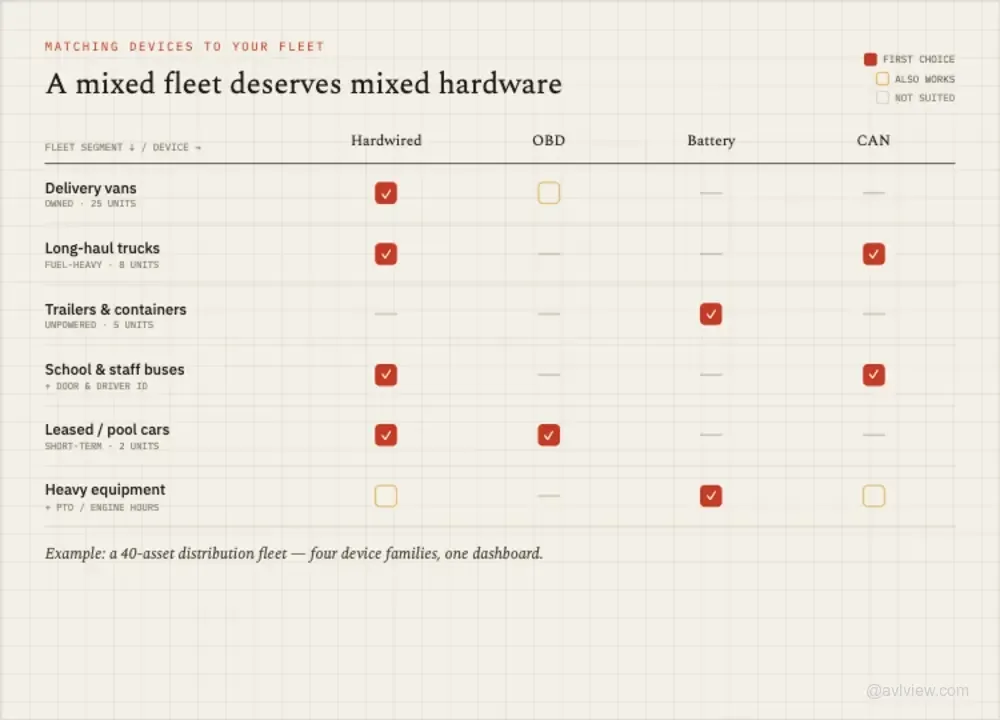
Here's how a typical mixed operation maps out — say a distribution company in Singapore running 40 assets:
- 25 delivery vans → hardwired trackers. Owned long-term, driver accountability matters, and covert installation ends the tamper conversation before it starts.
- 8 long-haul trucks → CAN telematics units with fuel sensors. Fuel is the #1 cost; the vehicle data pays for the hardware in the first quarter.
- 5 trailers → battery asset trackers. No power source, no problem — and the day one goes missing from a yard, the tracker earns five years of its subscription at once.
- 2 leased pool cars → OBD plug-ins. The lease ends in a year; the tracker moves to the next car in ten seconds.
Four device families, one AVLView dashboard — every asset on the same map, the same alerts, the same reports.
School and staff transport deserve one extra note: buses combine a hardwired or CAN unit with door sensors and driver ID — the hardware backbone behind school bus tracking.
The Add-Ons That Multiply a Tracker's Value
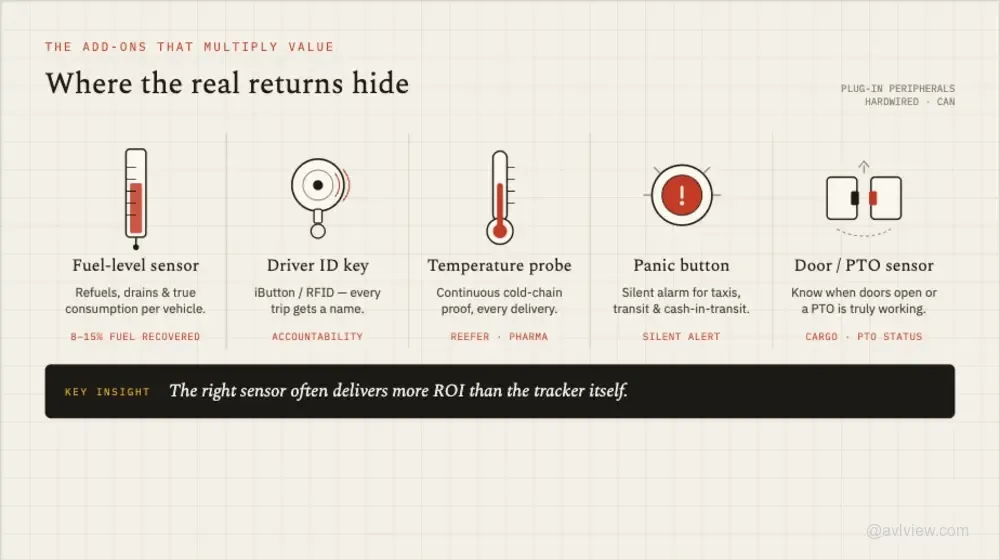
Most hardwired and CAN devices accept plug-in peripherals — and these are often where the real returns hide:
- Fuel-level sensors — the accessory with the fastest payback. Refuels, drains and true consumption per vehicle; typical fleets recover 8–15% of fuel spend.
- Driver ID keys (iButton/RFID) — every trip gets a name attached. Accountability, fair scoring, and an instant alert if a vehicle moves with no driver logged in.
- Temperature probes — non-negotiable for refrigerated and pharma transport; continuous cold-chain proof for every delivery.
- Panic buttons — a silent alarm for taxis, school transport and cash-in-transit (and a regulatory requirement in some markets).
- Door and PTO sensors — know when cargo doors open or when a crane, mixer or compactor is actually working, not just idling.
The One Decision That Outlasts the Hardware
Trackers get replaced every five to eight years. The platform relationship lasts much longer — which is why the most expensive mistake in this market isn't picking the wrong device. It's picking a locked platform that only works with its own hardware.
Lock-in means every future hardware decision is made for you, at the vendor's price. Device-agnostic platforms flip that: AVLView supports 200+ GPS tracker and telematics models across all four types above, from any reputable manufacturer. Your existing trackers usually reconnect as-is. Your next purchase is a price-and-fit decision, not a hostage negotiation.
That's the buying advice in one line: choose the platform for the long term, and the devices per vehicle, per job.
Tell us what's in your fleet — we'll map the right device type to every vehicle, free. Talk to us →
Frequently Asked Questions
Which is better: a hardwired or OBD GPS tracker?
Hardwired wins for vehicles you own long-term — it's covert, always powered and far harder to tamper with. OBD wins for speed and flexibility: ten-second installation and easy moves between vehicles, ideal for leased cars and fast rollouts. Many fleets run both, matched per vehicle.
Can I mix different GPS tracker types on one platform?
Yes — if the platform is device-agnostic. AVLView supports 200+ device models across hardwired, OBD, battery and CAN types, so a mixed fleet appears on one dashboard with one set of alerts and reports, regardless of which hardware each asset carries.
How long does a battery-powered asset tracker last?
From several weeks to 5+ years, depending on reporting frequency. A tracker reporting once daily can run for years; one reporting every few minutes while moving drains far faster. Most models let you configure the schedule to balance visibility against battery life.
Do GPS trackers work on motorcycles, generators and heavy equipment?
Yes. Motorcycles typically take compact hardwired units; generators and heavy equipment take either hardwired trackers (if powered) or rugged battery asset trackers (if not). Equipment-focused devices add PTO and engine-hour inputs so you can bill and service by actual usage.
Can I use the GPS trackers I already own with AVLView?
Usually, yes. AVLView is device-agnostic and supports over 200 tracker models — if your existing devices are from a mainstream manufacturer, they can typically be repointed to the platform without new hardware. Check the supported list or send us your device model and we'll confirm.
Last updated: July 2026.
Ready to Transform Your Fleet Operations?
See how AVLView helps fleet managers like you cut costs, improve safety, and boost efficiency with real-time GPS tracking.
Related Articles
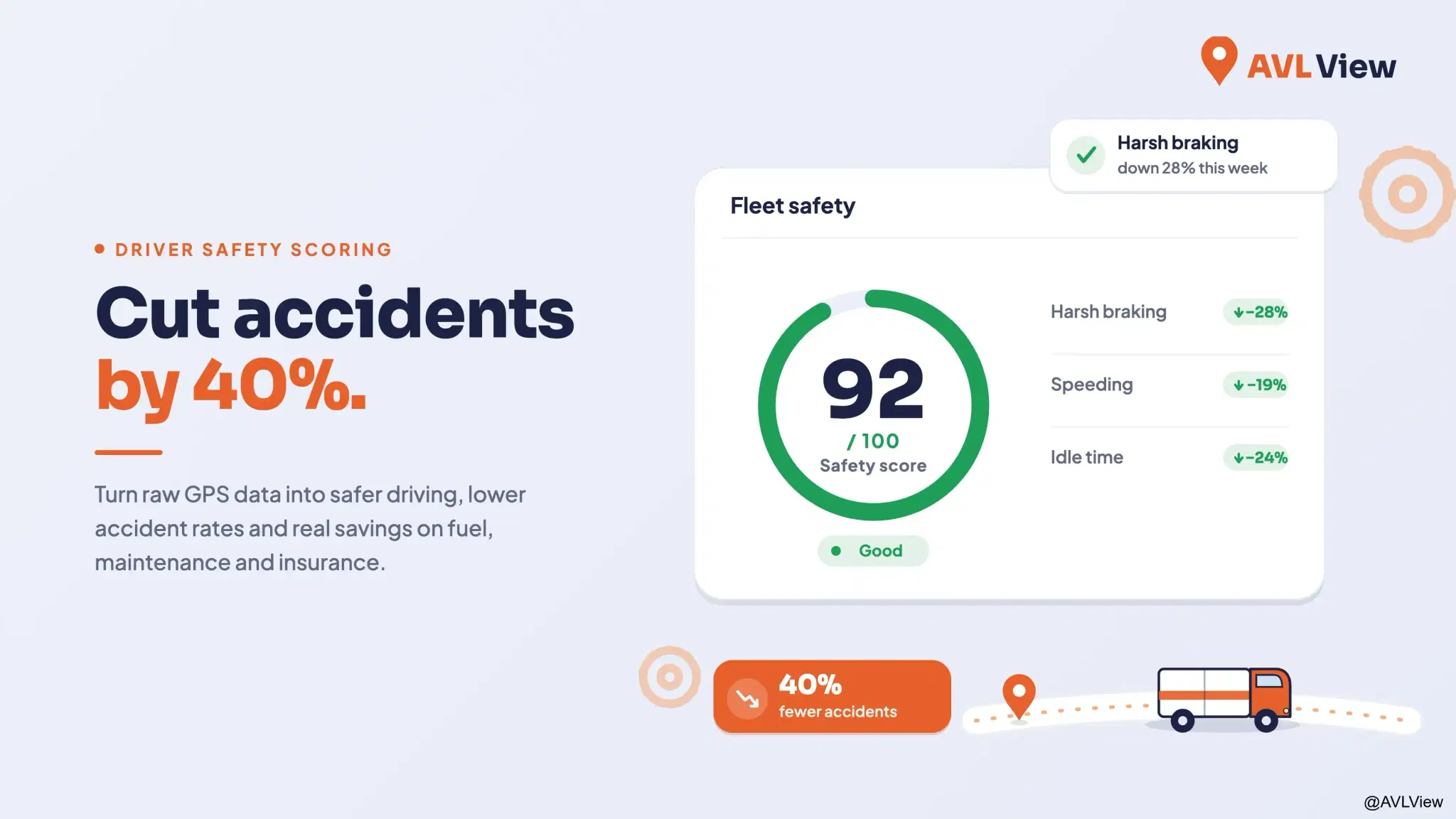
The Complete Guide to Driver Safety Scoring Systems
Learn how driver safety scoring systems work, how they reduce accidents by 40%, lower insurance premiums, and improve driving behaviour.
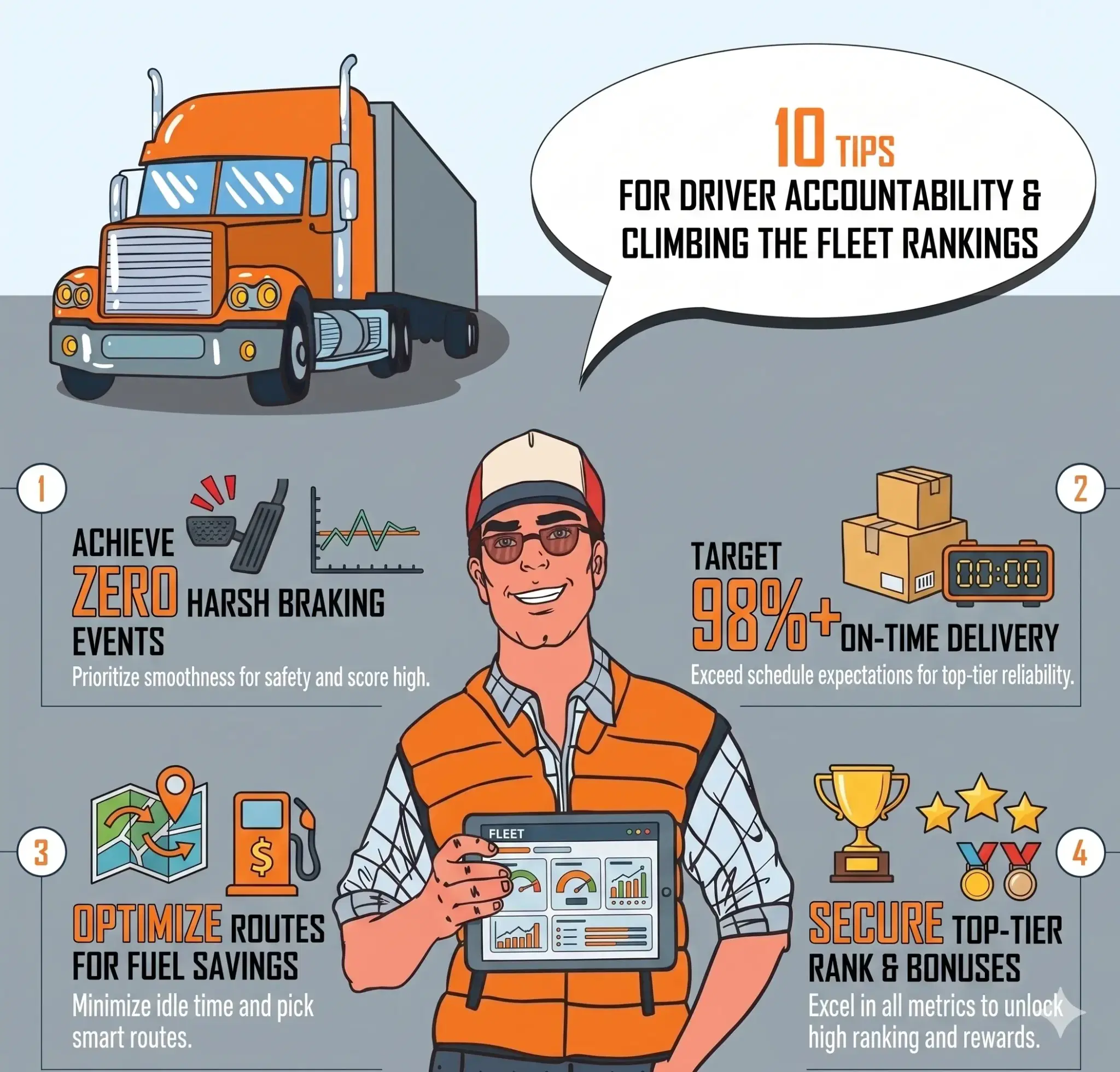
Driver Accountability: How Rankings Build Visibility and Healthy Competition
Rankings turn raw driving data into visible, comparable performance. See how safety scores, league tables, and trend tracking build accountability across your fleet.
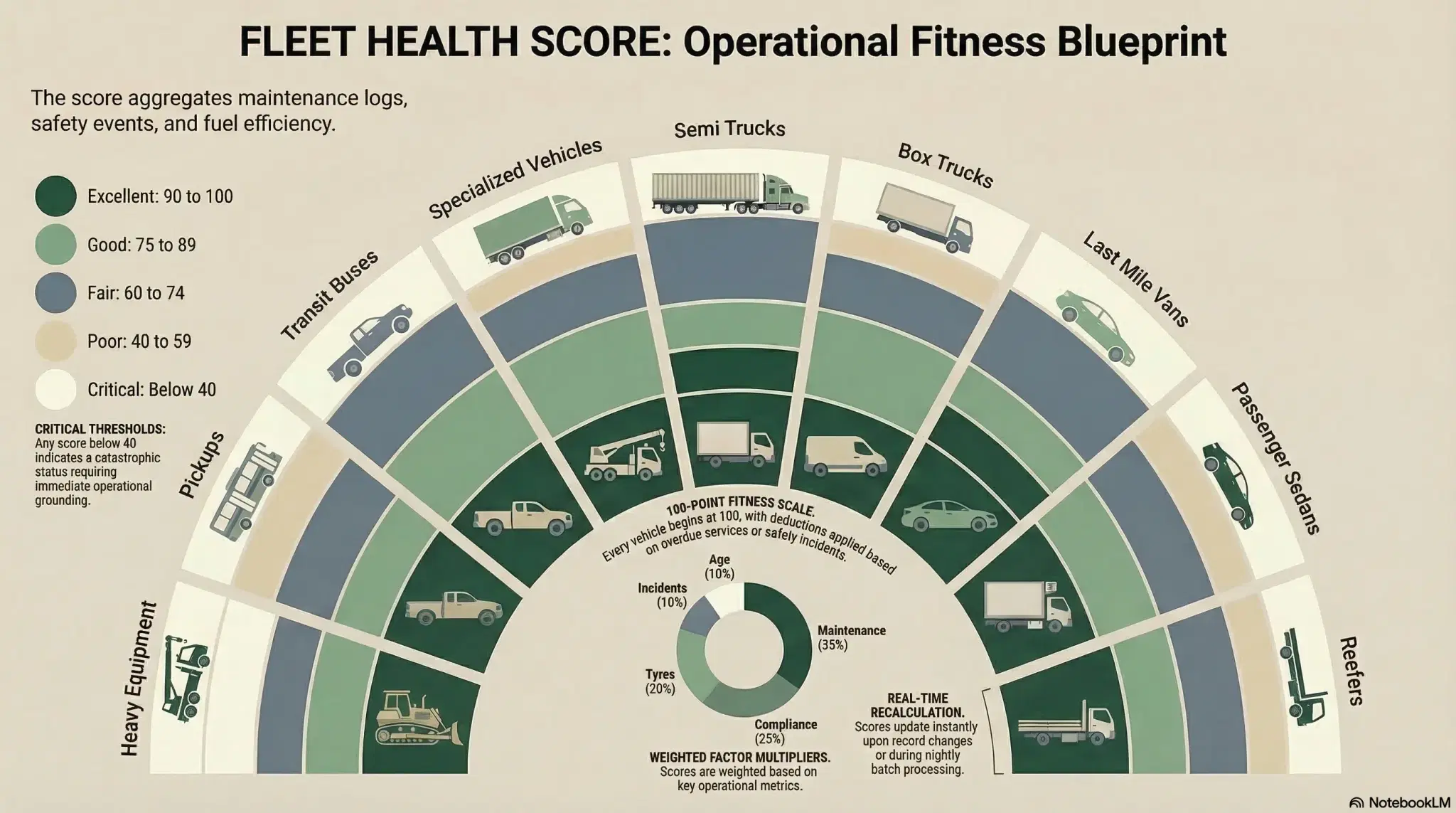
Fleet Health Score: One Number Per Vehicle
A single 0-100 fleet health score per vehicle replaces guesswork with clarity. Know exactly which vehicles need attention and why.
Join 43,000+ Fleet Owners Who Trust AVLView
AVLView helps you:
- Cut fuel costs by 8-15% within 90 days
- Improve driver safety and reduce accidents by 40%
- Get real-time visibility into every vehicle 24/7
- Automate reporting and save 10+ hours per week
- 30-day pilot program with no long-term commitment