Fuel Theft Prevention: How to Stop Fleet Fuel Loss
What You'll Learn
Fuel theft can quietly drain a tenth of your fuel budget. Here's the sensor-plus-software system that catches siphoning, fake fills and tampering.
Best for:
Fuel Management professionals and fleet managers
Fuel is the second-largest cost in most fleets — and the easiest to quietly steal. A driver siphoning 40 litres a week, or padding a fuel bill, rarely shows up until the annual numbers look wrong.
The good news: fuel theft is not invisible. A fuel-level sensor wired into a GPS device and read by the right software turns every drain, fill and disconnection into a timestamped, located, costed event. This guide shows exactly how that system prevents fuel theft — and the four alerts that catch it.
How much is fuel theft really costing you?
Most owners underestimate it because it hides inside "normal" consumption. A truck that should burn 30 litres on a route burns 34, and nobody questions four extra litres. Repeat that across a fleet, every day, and it compounds into a serious loss.
Fuel theft usually takes three forms:
- Siphoning — fuel physically drained from the tank while the vehicle is parked or idling.
- Fake fuel bills — a driver reports (and claims) more fuel than was actually put in the tank.
- Off-route detours — extra distance driven for personal use, burning fuel you pay for.
You can't fix what you can't see. Preventing theft starts with measuring fuel directly — not estimating it from distance.
The three parts of a fuel theft prevention system
A reliable fuel theft prevention setup is three things working together: a fuel-level sensor, a compatible GPS device, and fleet management software that turns the data into alerts and reports.
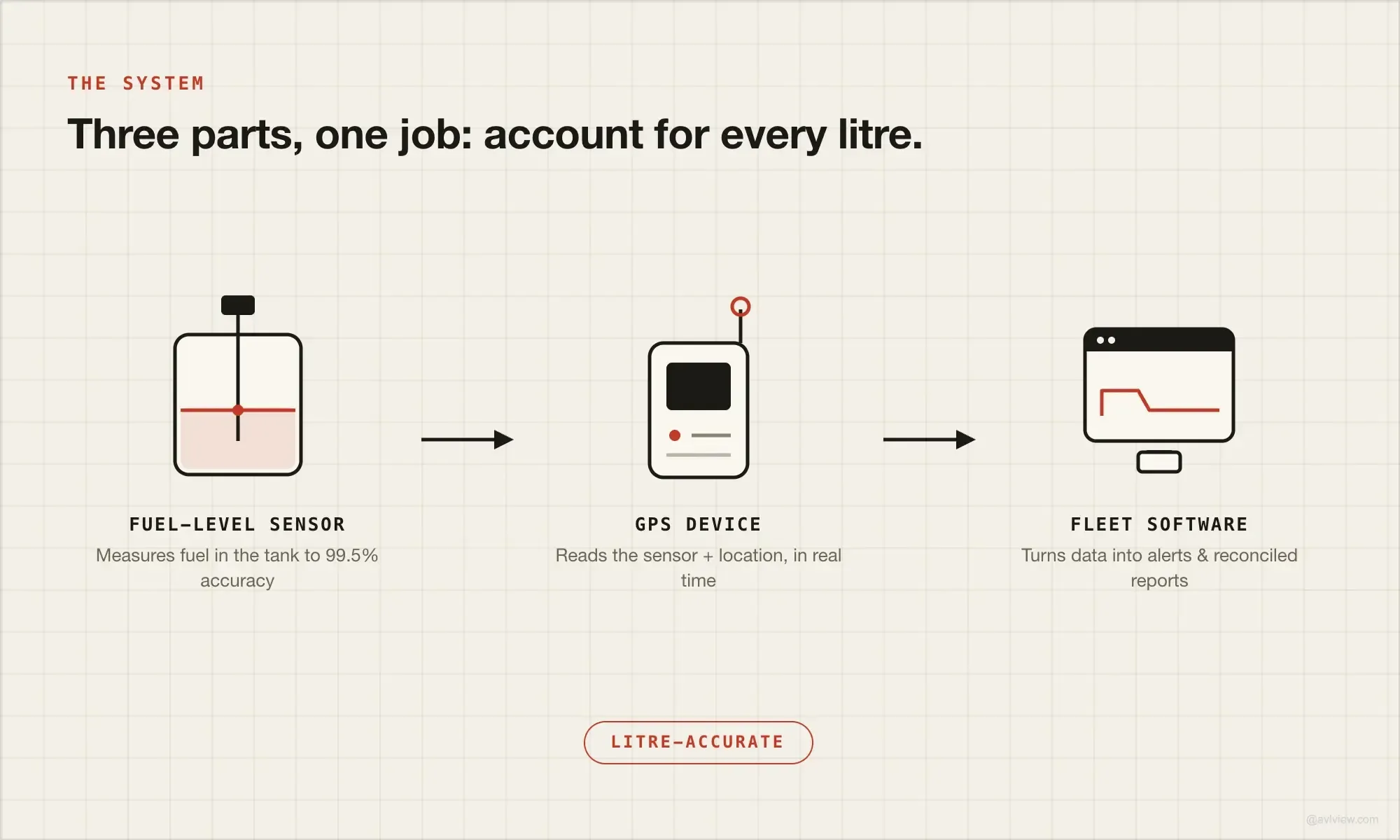
1. A fuel-level sensor you can trust
The sensor is the foundation — if it's inaccurate, everything downstream is noise. A good fuel-level sensor gives you:
- Sensor accuracy up to 99.5% in ideal conditions — with around 92% guaranteed in practice on well-conditioned tanks — so each litre is genuinely accounted for.
- A wide operating temperature range (−60 to +85°C, depending on model) — essential for fleets crossing hot Gulf routes or cold nights.
- Remote configuration, so it can be tuned without pulling it out of the tank.
- An 8–12 year lifetime, roughly the working life of the vehicle itself.
Choose the sensor for the tank it's going into: tank shape and condition affect accuracy, which is why professional installation and a calibration period matter.
2. A GPS device that reads the sensor
Not every tracker can read a fuel sensor — you need a device with the right serial input and feature set. When choosing one, look for:
- Compatibility with your fuel sensor and real-time location tracking
- Fuel monitoring, temperature monitoring and driver behaviour inputs
- Digital input/output for remote monitoring, and sensor-disconnection detection
- Good build quality, IP protection, battery backup and after-sales support
Hardware quality decides performance. A cheap device that drops its connection leaves gaps a driver can exploit. If you're weighing basic tracking against sensor-grade telematics, our GPS tracking vs telematics guide lays out the difference.
3. Software that turns data into alerts
A sensor and device produce data; the software makes it useful. A reliable fleet platform shows live fuel level alongside location and status, flags refuels and drains the moment they happen, and generates fuel reports that reconcile every litre.
This is where prevention becomes real — you're alerted while there's still time to act, not at month-end when the fuel is long gone.
The four alerts that actually catch theft
Prevention lives in the alerts. These four catch the overwhelming majority of fuel loss.
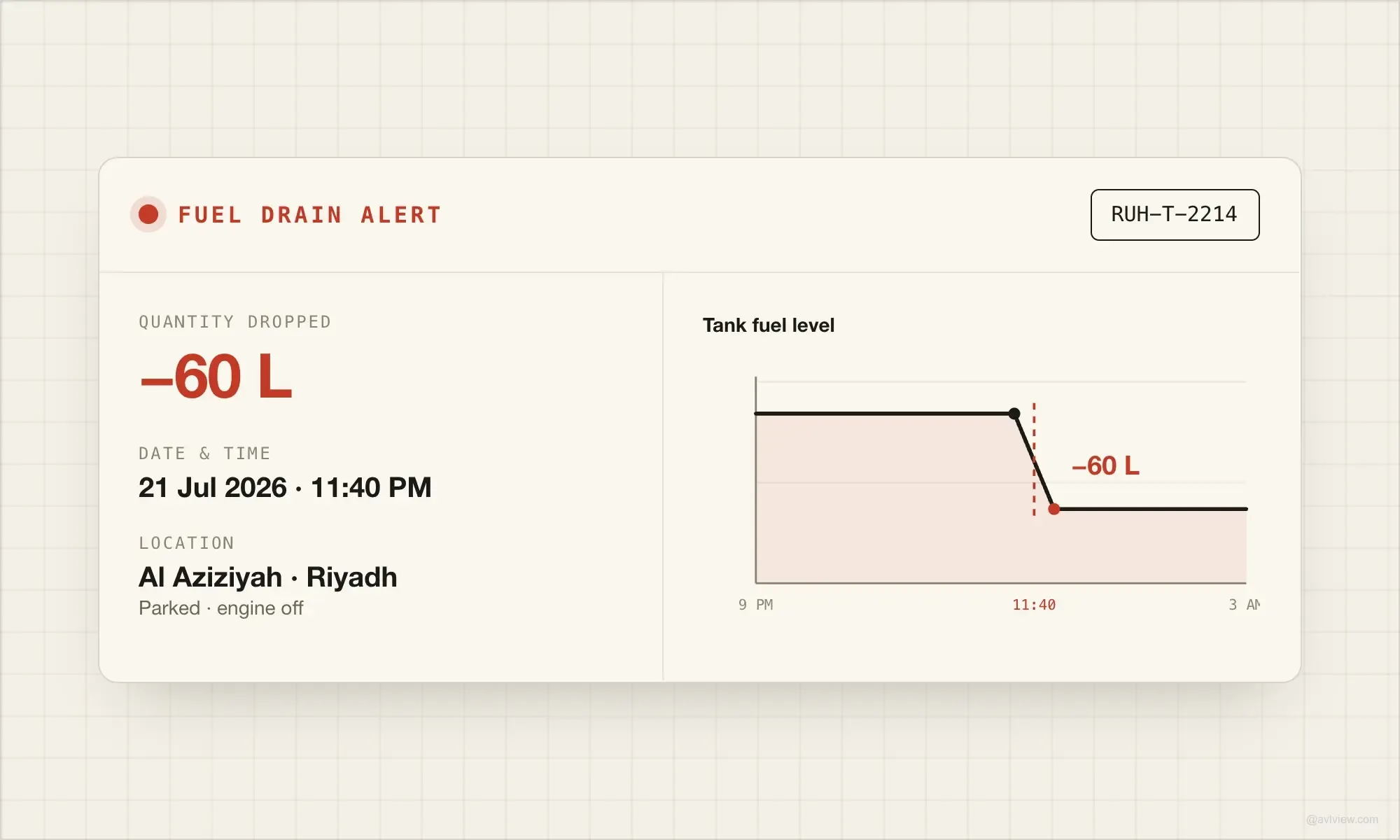
- Refuel alert — fires on any fill-up, with the exact quantity, date and time. This is what makes verifying driver fuel bills easy: the tank tells you how many litres actually went in, so a padded receipt stops working.
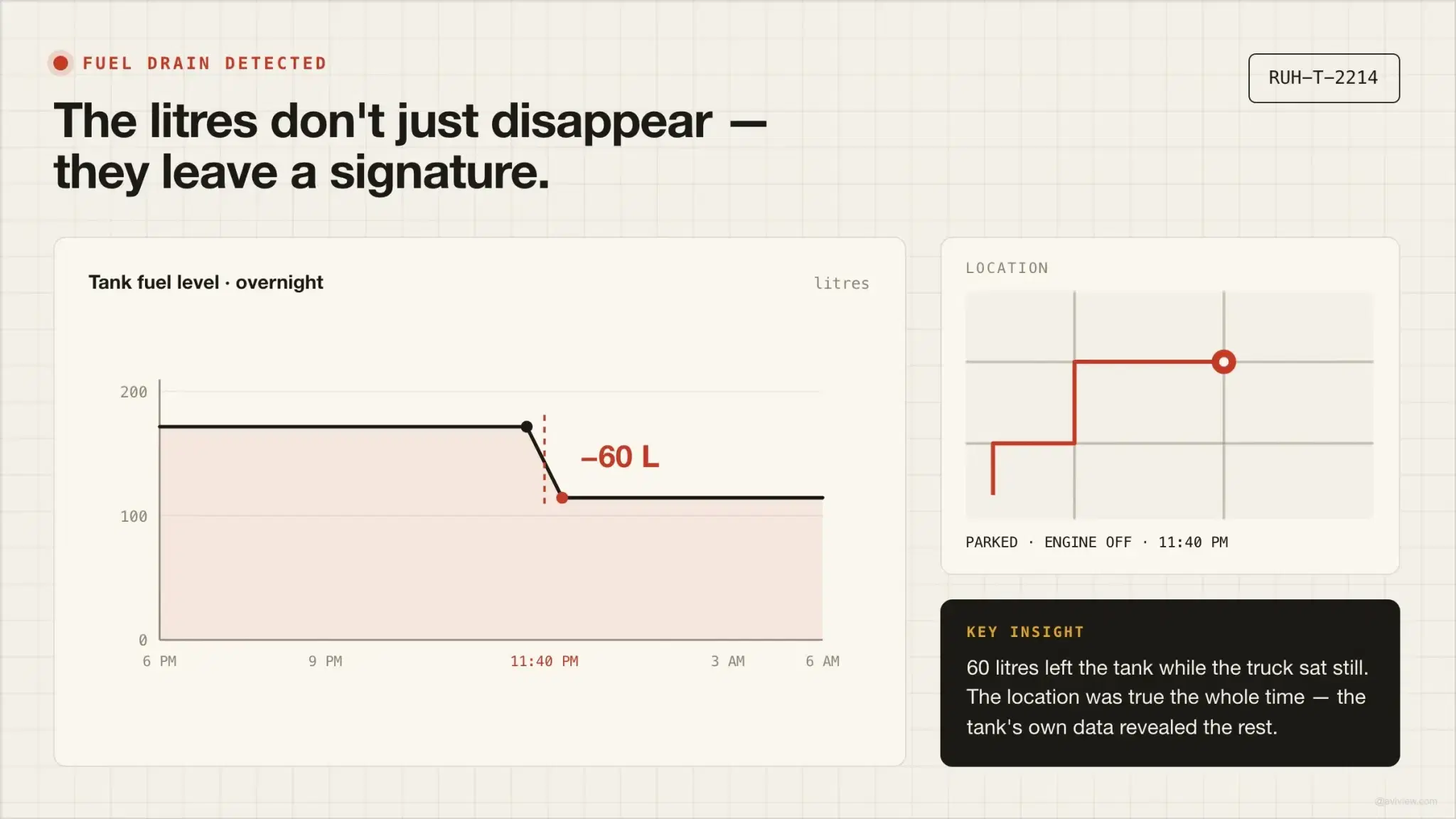
- Fuel drain alert — fires when the level drops sharply beyond a set threshold, reporting the quantity, date and time. A 60-litre drop at midnight on a parked truck is a drain alert, not a mystery.
- Sensor disconnection alert — fires the moment the fuel sensor is unplugged. Drivers who know they're monitored sometimes disconnect the sensor; this turns that tampering into its own red flag.
- Route deviation alert — a route fence tells you when a vehicle leaves its assigned route, catching the off-book detours that burn fuel you pay for.
See how AVLView monitors fuel and flags theft →
A worked example: the 60 litres that vanished at midnight
A distribution fleet in Riyadh ran eight trucks. Locations always checked out — every route looked clean — but truck RUH-T-2214 kept burning roughly 20% more diesel than its identical twin on the same run.
Distance-based reports had no answer; both trucks drove the same kilometres. Once a fuel-level sensor was wired in, the curve showed it plainly: a 60-litre drop at 11:40 pm, engine off, parked at the driver's home stop.
Siphoning. The location data had been true the whole time — the truck was where it should be. It took the tank's own data to reveal what happened while it sat there. The drain alert went live, and the behaviour stopped the same week.
Fake fuel bills: reconciling what drivers report
Verifying fuel bills by hand has never worked well, and padded receipts are a common way to earn a quiet "extra income." A refuel alert closes that gap.
Because the system records the actual quantity added to the tank — with date, time and location — you can reconcile it against the receipt the driver submits. If a bill says 50 litres and the tank rose by 38, you have an itemised, located discrepancy to act on, not a hunch.
That single check often pays for the sensor within months on a mid-sized fleet.
Why drivers disconnect the sensor
The most direct way to defeat fuel monitoring is to unplug the sensor — so a good system watches for exactly that.
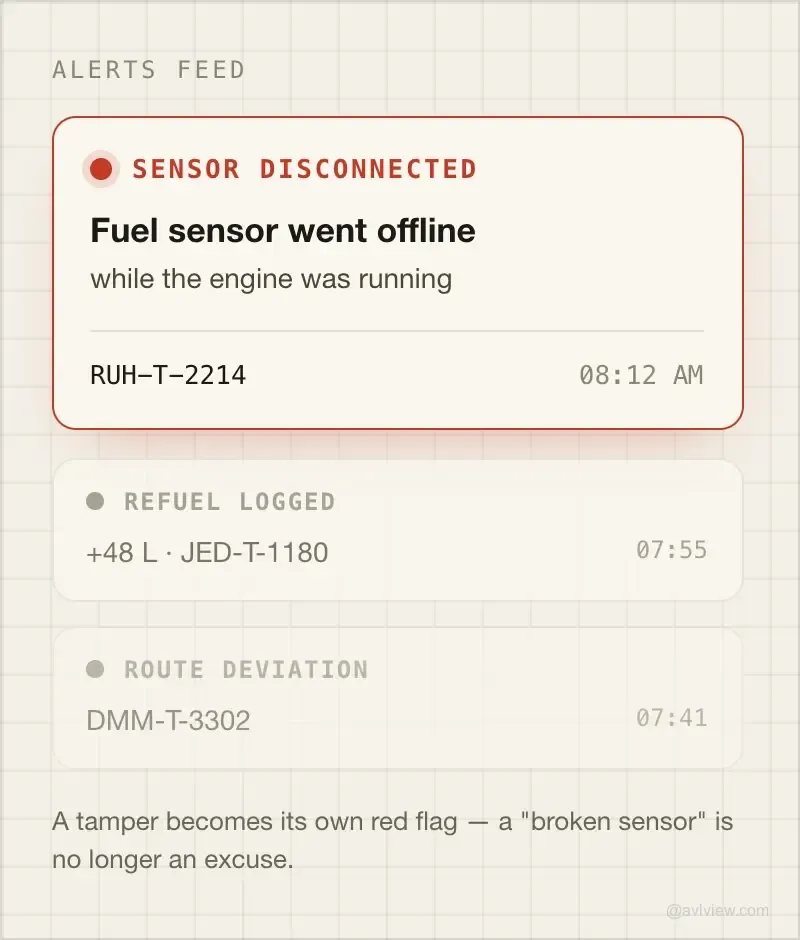
A sensor-disconnection alert flags the tamper the instant it happens, so a "broken sensor" is no longer a convenient excuse. It's the fuel-specific cousin of the wider tampering playbook we cover in how drivers cheat GPS trackers — every trick leaves a signature if the alerts are switched on.
Getting started: a simple checklist
You don't need to boil the ocean. Start where the loss is biggest.
- Fit fuel-level sensors to your highest-consumption vehicles first — tankers, long-haul trucks, heavy equipment.
- Set the three core alerts — refuel, drain and sensor disconnection — with thresholds tuned to each tank.
- Reconcile fuel bills against refuel data for one month and measure the gap.
- Add route fences to the vehicles where personal use is a risk.
- Review the fuel report weekly and act on every flagged litre.
Stop paying for fuel you never burned
Fuel theft feels unstoppable only while it's invisible. Measure fuel directly, switch on the alerts, and it becomes an itemised, costed list you can actually manage — usually recovering a meaningful slice of a fleet's single biggest controllable cost.
AVLView supports 200+ GPS and telematics devices and the leading fuel-level sensors, so you can start on a few vehicles and scale as the savings prove out.
Related fuel guides
FAQ
How does a fuel monitoring system prevent theft?
It measures the fuel in the tank directly with a fuel-level sensor, rather than estimating it from distance. When fuel drops sharply, a fill is logged, or the sensor is disconnected, the system raises a timestamped, located alert — so siphoning, padded bills and tampering are caught while you can still act.
How accurate is fuel theft detection?
Fuel-level sensors can measure to up to 99.5% in ideal conditions, with AVLView guaranteeing around 92% in practice on well-conditioned square or rectangular tanks (about 85% on oval). Drain and refuel events are reported with the quantity, date, time and location. Accuracy depends on tank shape, tank condition and calibration, which is why professional installation and a calibration period matter.
Can drivers beat fuel monitoring by unplugging the sensor?
They can try, but a sensor-disconnection alert fires the moment the sensor goes offline — turning the tamper itself into a flag. Combined with power-cut and GPS-loss alerts, a "faulty sensor" stops being a usable excuse.
Will fuel monitoring catch fake fuel bills?
Yes. A refuel alert records the actual litres added to the tank, so you can reconcile it against the receipt a driver submits. A bill that claims more litres than the tank received is flagged automatically.
Do I need special hardware for fuel theft prevention?
You need a fuel-level sensor and a GPS device that can read it — a basic location-only tracker is not enough. AVLView is device-agnostic across 200+ models and the main fuel sensors, so most fleets can add fuel monitoring to their existing setup rather than replacing it.
Ready to Transform Your Fleet Operations?
See how AVLView helps fleet managers like you cut costs, improve safety, and boost efficiency with real-time GPS tracking.
Related Articles
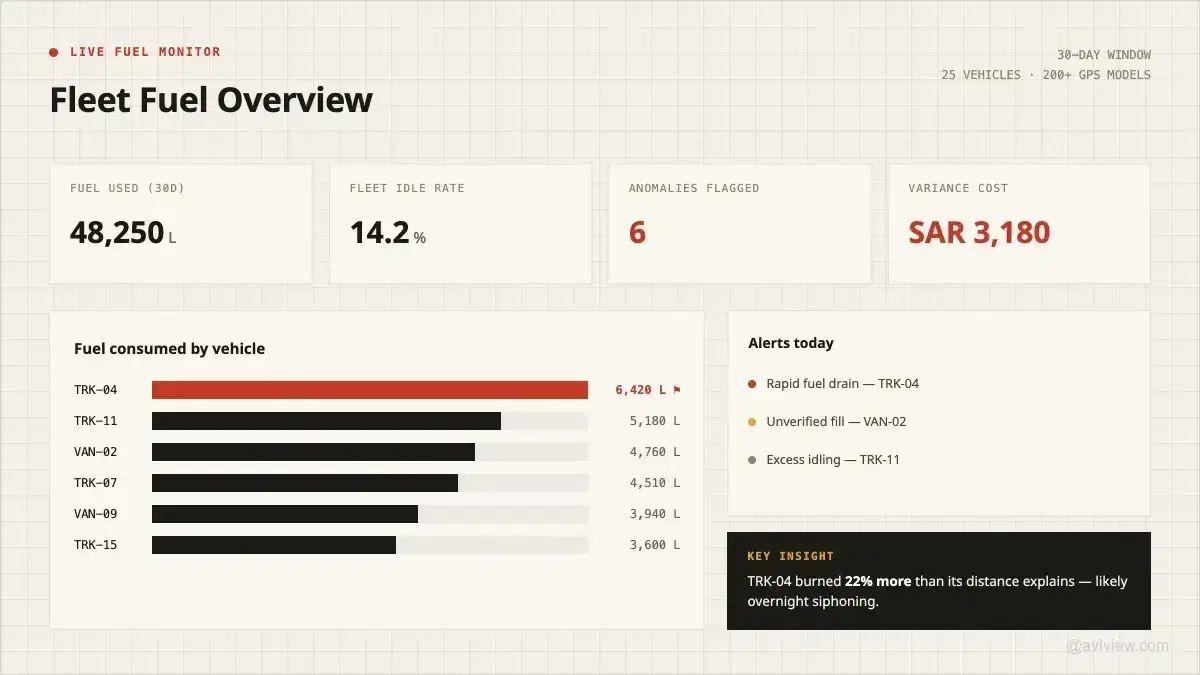
Fuel Consumption Control for Fleet Management
Fuel is your biggest controllable fleet cost. See the four levers — and the reports — that cut fuel spend 8–15%: idling, routes, driving and theft.
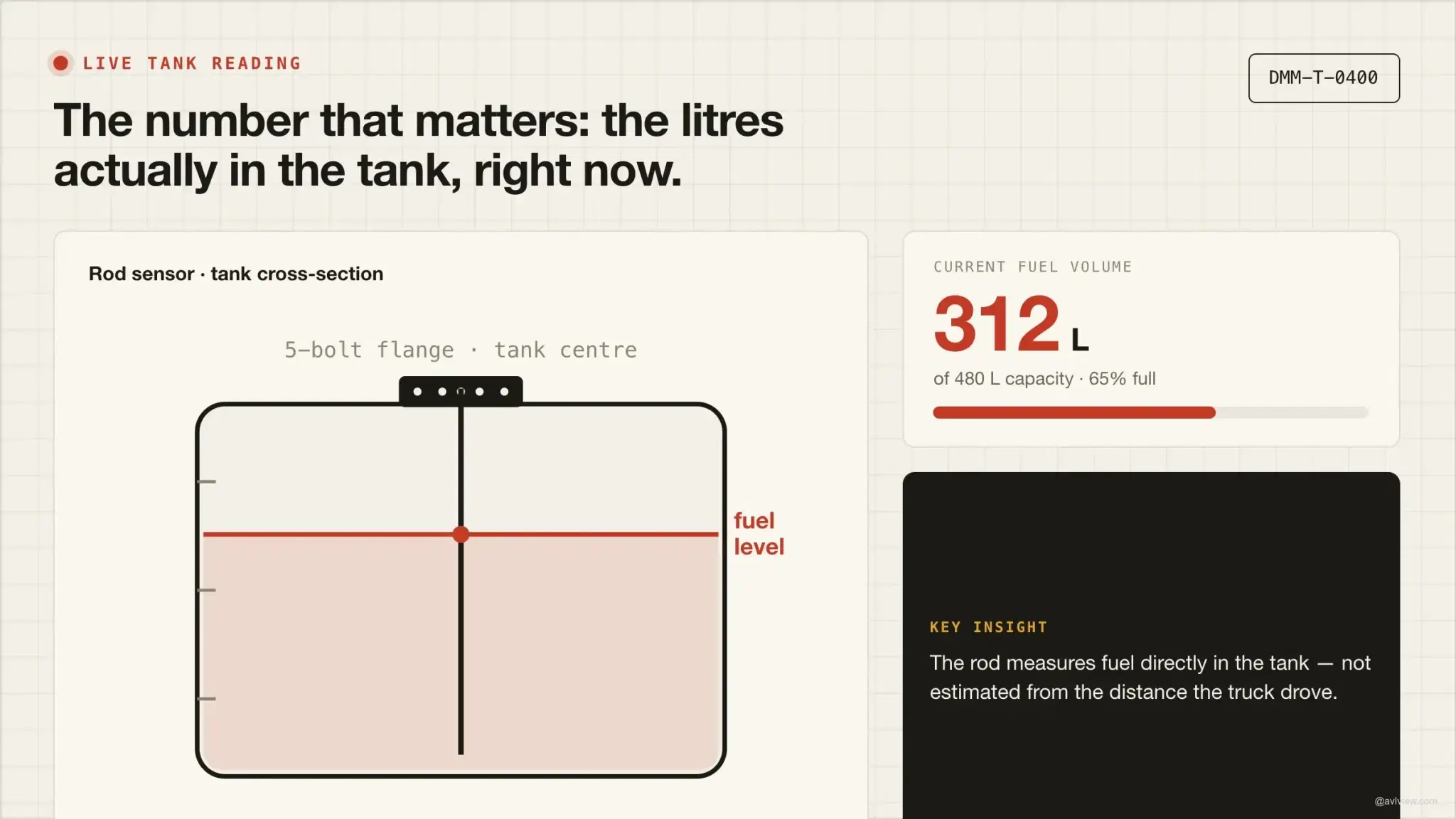
Fuel Level Sensors: How Fleet Fuel Monitoring Works
A fuel level sensor measures diesel directly in the tank — no guessing from distance. Here's how fleet fuel monitoring works, and how accurate it is.

Fuel Tracking System for Trucks & Diesel Fleets
Diesel truck fleets pay back fastest. Fleet fuel tracking measures litres per 100 km, compares near-identical trucks, and catches siphoning at rest.
Join 43,000+ Fleet Owners Who Trust AVLView
AVLView helps you:
- Cut fuel costs by 8-15% within 90 days
- Improve driver safety and reduce accidents by 40%
- Get real-time visibility into every vehicle 24/7
- Automate reporting and save 10+ hours per week
- 30-day pilot program with no long-term commitment