Fuel Level Sensors: How Fleet Fuel Monitoring Works
What You'll Learn
A fuel level sensor measures diesel directly in the tank — no guessing from distance. Here's how fleet fuel monitoring works, and how accurate it is.
Best for:
Fuel Management professionals and fleet managers
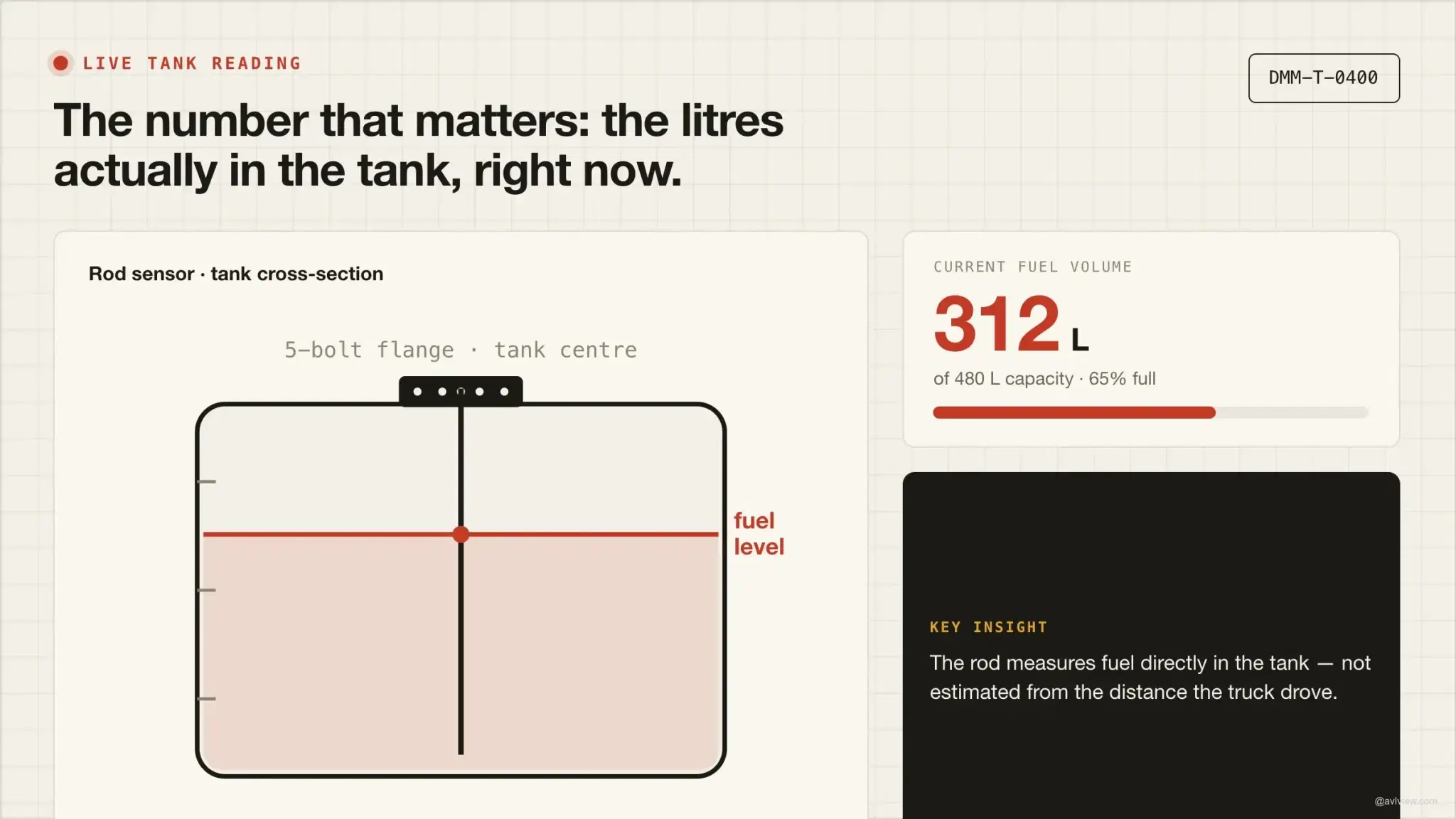
A fuel level sensor is a probe fitted inside a vehicle's fuel tank that measures how much fuel is actually in it, in real time. Instead of estimating consumption from the distance a truck drives, a fuel level sensor reads the true fuel volume — so you can see refuelling, theft and consumption as they happen.
This guide explains how fuel level monitoring works at the hardware level, which vehicles it suits, and — honestly — how accurate it is. Fuel monitoring is only as trustworthy as the sensor and the calibration behind it, so we'll cover both plainly.
What a fuel level sensor actually does
A digital fuel rod sensor sits vertically inside the tank and outputs a signal that maps to the current fuel level. Read by the right software, that one signal does four useful jobs.
- Reliable current fuel volume — how much fuel is in the tank at any moment.
- Fuelling volume — the exact quantity added at each fill.
- Theft detection — the sudden drops that distance-based reports never see.
- Consumption and remote monitoring — real litres burned, viewable from the office.
Every one of those depends on the sensor reading the tank correctly — which is exactly where suitability and calibration come in.
How fuel level monitoring works, step by step
The chain is short, but each link matters.
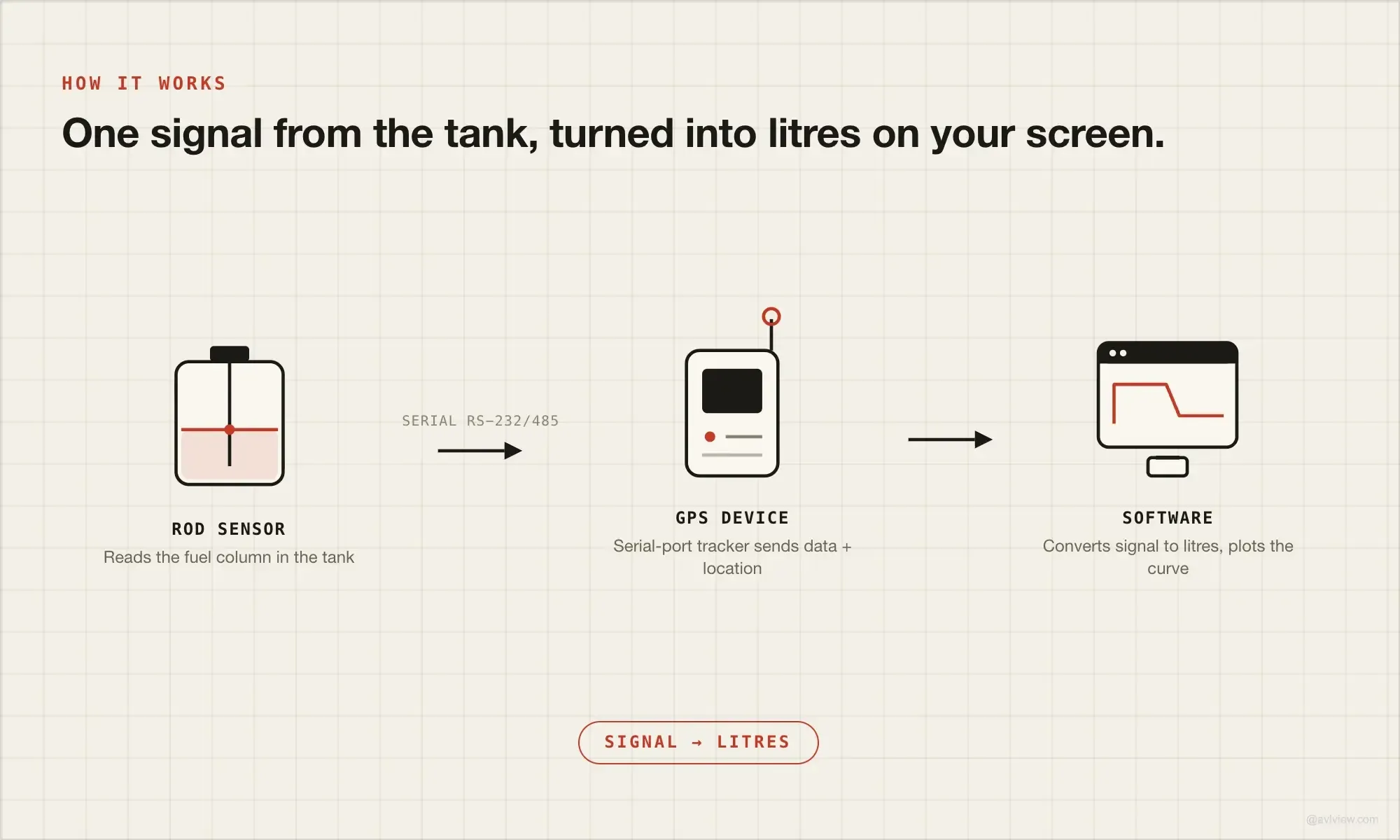
- The rod sensor measures the fuel level continuously inside the tank.
- It sends that reading over a serial connection (RS-232/RS-485) to the GPS device.
- Only advanced GPS/GPRS trackers with a serial port can read a digital rod sensor — a basic location-only tracker cannot.
- The device transmits the fuel data along with location and time to the platform.
- The software converts the raw signal into litres using the tank's calibration table, then plots the fuel curve.
That serial-port requirement is why device choice matters. If you're mapping out hardware options, our guide to GPS tracking device types covers which trackers support sensor inputs.
Which vehicles suit a fuel level sensor (and which don't)
A rod sensor needs a tank it can sit in cleanly and read from top to bottom. That makes it a strong fit for some vehicles and a poor one for others.
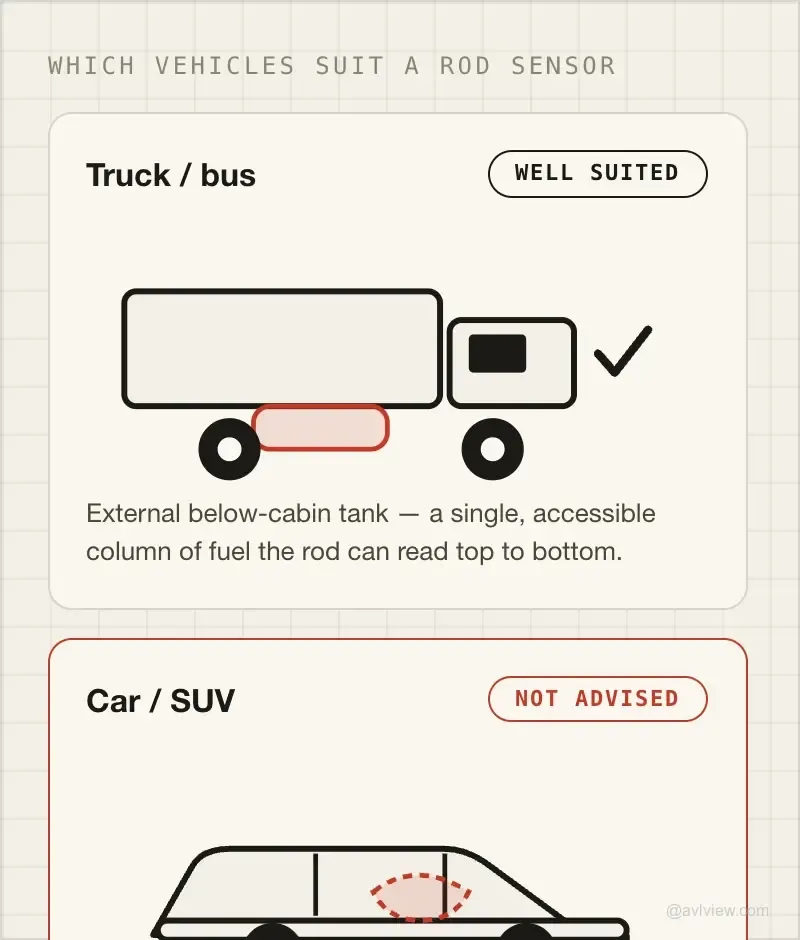
Well suited: trucks, lorries, buses and JCB-type heavy equipment — vehicles where the fuel tank sits externally, below or beside the cabin, in a single accessible chamber.
Not possible: shovel loaders and similar machines whose tank sits inside the chassis and is split into compartments. There's no clean, single column of fuel for the rod to measure.
Not advised: sedans, SUVs, cars and pickups. Their tanks are built into the body in awkward, saddle-shaped positions, so a rod sensor can't give a dependable reading. For light vehicles, location tracking and consumption estimates are the sensible route.
Want to see fuel level, refuels and drains on a live map for your own trucks? See how AVLView monitors fuel across your fleet →
How accurate is a fuel level sensor, honestly?
This is where a lot of vendors go quiet, and where we won't. The sensor hardware can reach up to 99.5% in ideal conditions, but the figure that matters is what's guaranteed on your actual tank. Accuracy is real but bounded, and it depends heavily on the tank.
On a well-conditioned square or rectangular tank, a rod sensor is guaranteed to around 92% accuracy. On an oval tank the geometry is harder to map, so the guarantee is around 85%. Three things move that number:
- Tank condition — dents and deformation distort the shape the calibration assumes, which lowers accuracy.
- Distance travelled — the longer a vehicle runs, the more the reading settles. Short-distance readings bounce around with fuel slosh and should be ignored.
- Event size — a drain or refill should be at least 15% of tank capacity to register cleanly. Smaller movements can hide in the noise.
This is why we ask fleets to read the weekly report, not the minute-by-minute figure. Over a full shift the curve settles and the numbers reconcile.
A worked example: two identical tankers, one honest tank
A logistics operator in Dammam ran two identical trucks with 400-litre rectangular tanks on the same route. On paper both should have burned the same diesel; one consistently cost more.
Distance reports couldn't explain it — same kilometres, same load. After a rod sensor was fitted and calibrated, the weekly fuel curve told the story: a clean 70-litre drop at a parked yard stop, engine off.
That drop was about 17% of the tank — comfortably over the 15% threshold and well inside the sensor's reliable range, so there was no ambiguity. The reading held up because the truck had run a full route that day and the curve had settled; a short idle-yard reading alone would never have proved it. Catching that pattern reliably is the subject of our fuel theft prevention guide.
Installation and calibration: what really happens
Getting to that 92% isn't plug-and-play — it's a proper fit followed by a proper calibration.
- Before install, share clear photos of the tank so the technical team can analyse its shape, size and mounting.
- The sensor mounts through a 5-bolt flange at the geometrical centre of the tank, so the rod reads the truest column of fuel.
- A typical installation takes around 5 hours.
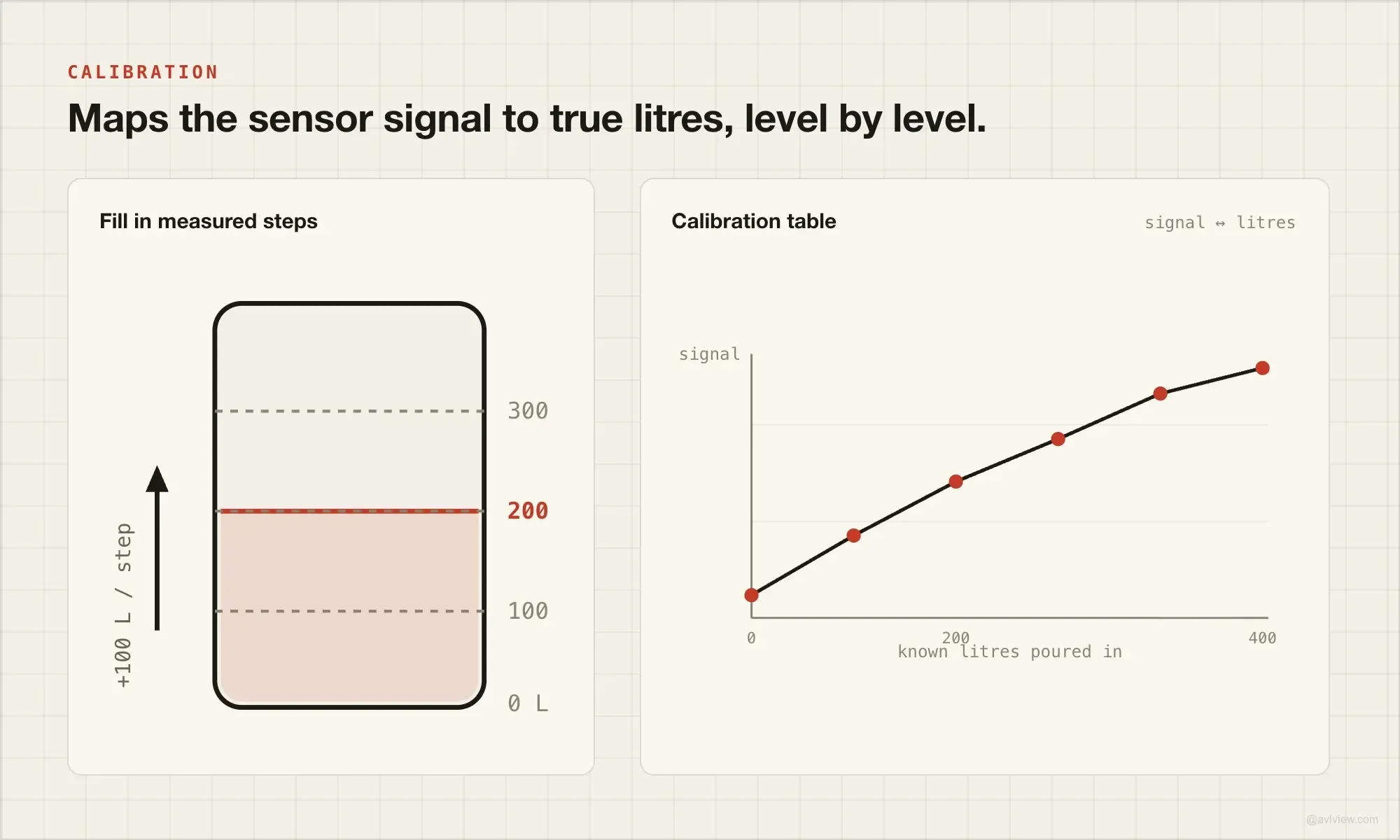
Then comes calibration, and it can't be skipped. The tank is emptied and refilled in measured steps while the software records the sensor's signal at each level — building a calibration table that maps signal to true litres.
For that, the client arranges a fuel storage facility sized to the tank, so fuel can be drained and returned during the process. Skipping calibration is the single most common cause of a sensor that later "reads wrong."
The first 30 days: fine-tuning to committed accuracy
A freshly installed sensor is close, not final. It needs about 30 days of live monitoring and fine-tuning to reach its committed accuracy.
During that month the client monitors each refuelling and shares the data, so readings can be trimmed against real fills. After that, keep it honest: report any later tank alteration, keep standard wheels fitted, and maintain correct tyre pressure — all three change how the vehicle sits, and therefore how the tank reads.
Treated this way, a fuel level sensor becomes the most trustworthy number in your fleet — the litres that are actually in the tank, right now.
Put real fuel numbers behind every truck
A fuel level sensor turns fuel from a monthly guess into a live, litre-level fact — provided it's matched to the right vehicle, installed at the tank's centre, and calibrated properly.
AVLView supports 200+ GPS devices and the leading digital rod sensors, so you can start with your heaviest-consuming trucks and scale from there as the numbers prove out.
FAQ
What is a fuel level sensor and how does it work?
A fuel level sensor is a rod-shaped probe fitted inside a vehicle's fuel tank that measures the current fuel volume in real time. It sends a signal over a serial connection to a GPS device, and software converts that signal into litres using the tank's calibration table — so you see actual fuel level, fills and drains rather than an estimate from distance.
How accurate is a fuel level sensor?
The sensor can reach up to 99.5% in ideal conditions; in practice, accuracy is guaranteed to around 92% on a well-conditioned square or rectangular tank and around 85% on an oval tank. Accuracy depends on tank condition, distance travelled and calibration, so it's best read from the weekly report — short-distance readings settle over a full shift and should not be judged in isolation.
Which vehicles can use a fuel level sensor?
Trucks, lorries, buses and JCB-type heavy equipment are ideal, because their tanks sit externally in a single accessible chamber. It's not possible on shovel loaders with compartmented in-chassis tanks, and not advised for sedans, SUVs, cars and pickups, whose internal saddle-shaped tanks can't be read reliably by a rod sensor.
Why does a fuel level sensor need calibration?
The sensor outputs a raw signal, not litres. Calibration empties and refills the tank in measured steps to build a table that maps each signal value to a true fuel level — without it, the readings have nothing accurate to translate against. A new sensor then needs about 30 days of fine-tuning to reach its committed accuracy.
Can a fuel level sensor detect fuel theft?
Yes. Because it measures the fuel in the tank directly, it registers sudden drops that distance-based reports never see — provided the drain is at least 15% of tank capacity. Paired with software alerts, those drops become timestamped, located events, which is the core of any fuel theft prevention setup.
Ready to Transform Your Fleet Operations?
See how AVLView helps fleet managers like you cut costs, improve safety, and boost efficiency with real-time GPS tracking.
Related Articles
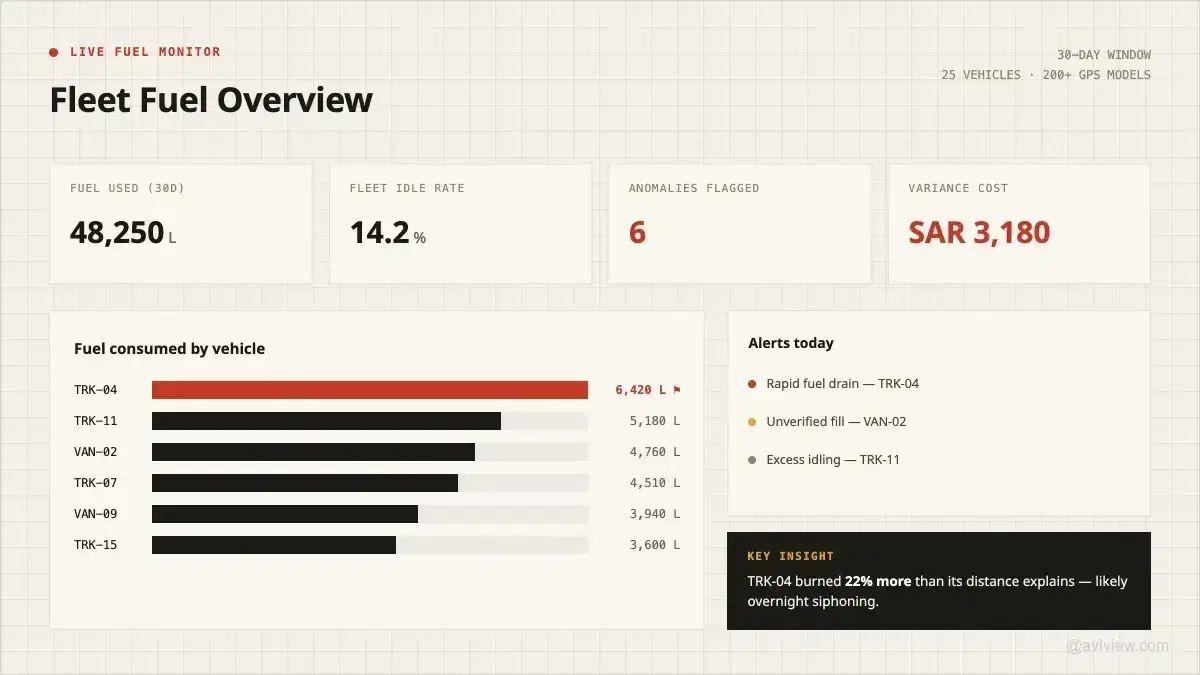
Fuel Consumption Control for Fleet Management
Fuel is your biggest controllable fleet cost. See the four levers — and the reports — that cut fuel spend 8–15%: idling, routes, driving and theft.
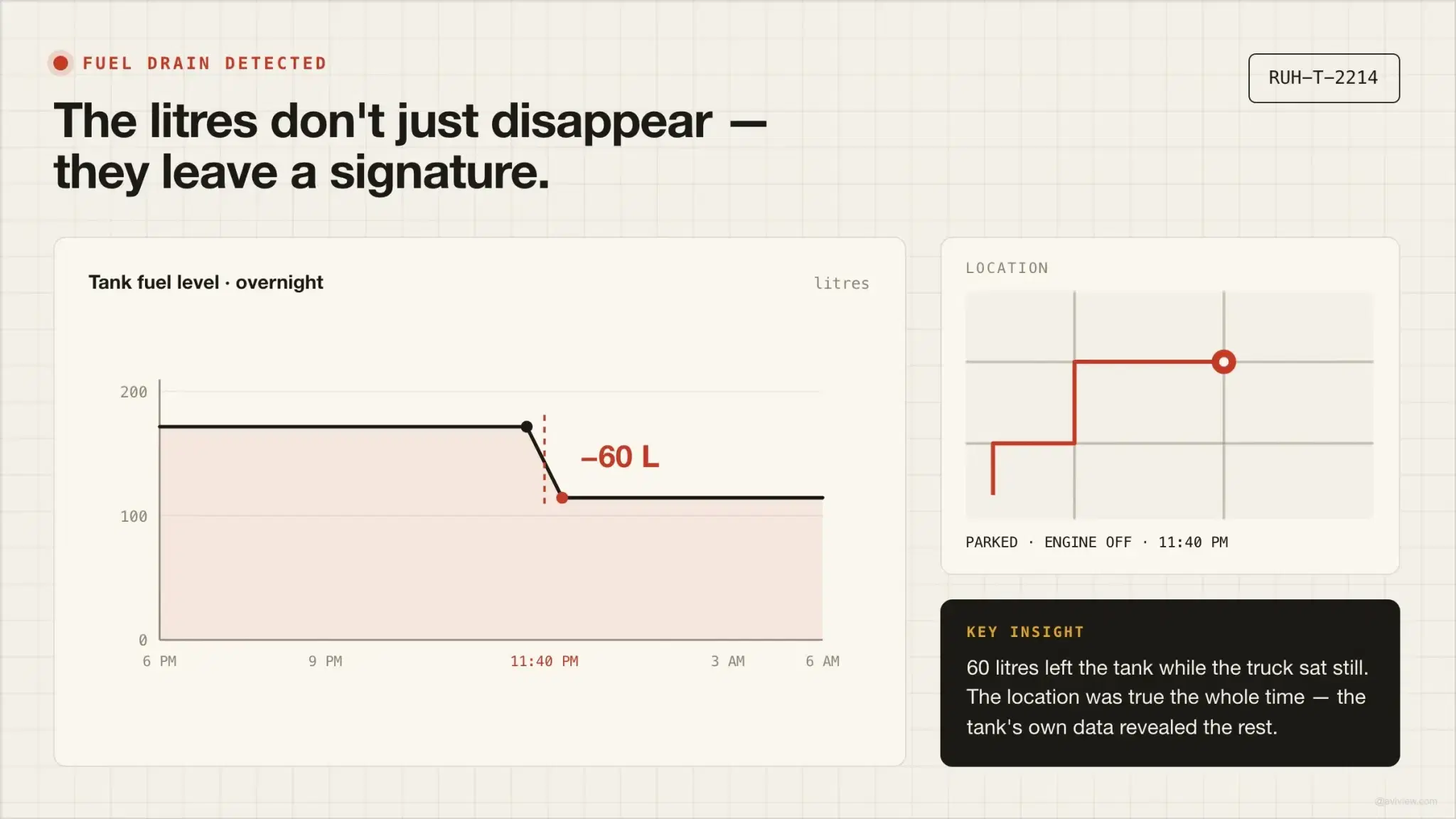
Fuel Theft Prevention: How to Stop Fleet Fuel Loss
Fuel theft can quietly drain a tenth of your fuel budget. Here's the sensor-plus-software system that catches siphoning, fake fills and tampering.

Fuel Tracking System for Trucks & Diesel Fleets
Diesel truck fleets pay back fastest. Fleet fuel tracking measures litres per 100 km, compares near-identical trucks, and catches siphoning at rest.
Join 43,000+ Fleet Owners Who Trust AVLView
AVLView helps you:
- Cut fuel costs by 8-15% within 90 days
- Improve driver safety and reduce accidents by 40%
- Get real-time visibility into every vehicle 24/7
- Automate reporting and save 10+ hours per week
- 30-day pilot program with no long-term commitment