AIS 140 and VLTD Devices in India: Rules, Certification, Registration and Costs (2026)


What You'll Learn
A plain-English guide to India's AIS 140 mandate: VLTD rules, certified devices, state backends, registration steps, costs and penalties for 2026.
Best for:
Compliance professionals and fleet managers
AIS 140 is Automotive Industry Standard 140, the technical standard published under the Ministry of Road Transport and Highways (MoRTH) that defines the tracking device every public service and commercial vehicle in India must carry.
That device is a VLTD, a Vehicle Location Tracking Device.
It sends the vehicle's position to a government backend and has an emergency button the driver or passengers can press.
Since the Supreme Court's May 2026 order, no state may issue a fitness certificate or a permit to a public service vehicle unless a working VLTD shows against it in Vahan. A rule most operators ignored for seven years now stops a vehicle at its next fitness renewal.
This guide is for fleet owners, transport operators, school and staff transport contractors, and the resellers who fit devices for them. It covers the whole country. If you operate in Kerala, our KMVD AIS 140 guide for Kerala walks through Suraksha Mitr and the state process in detail.
What AIS 140 is (and what it is not)
The standard itself is a document. It was drafted by the Automotive Industry Standards Committee and published through ARAI in 2016. It describes a device: how accurately it must fix position, how often it must report, what happens when the emergency button is pressed, how it behaves when parked, and how it talks to a server.
What makes it law is a different document.
In November 2016 MoRTH inserted Rule 125H into the Central Motor Vehicles Rules, 1989 (G.S.R. 1095(E), 28 November 2016).
Rule 125H says public service vehicles must be fitted with a vehicle location tracking device and an emergency button meeting AIS 140. Two-wheelers, three-wheelers, e-rickshaws and transport vehicles that need no permit are left out.
So when someone says "AIS 140 is mandatory", they mean Rule 125H is mandatory, and Rule 125H points at AIS 140.
A compliant VLTD does three things:
- Knows where the vehicle is, using GPS and India's own NavIC constellation.
- Carries an emergency button that sends an alert with location to the state control room.
- Reports to a government backend, not only to the vendor's app. Each state runs its own.
The terms you will meet along the way:
| Term | Full form | What it means in practice |
|---|---|---|
| AIS 140 | Automotive Industry Standard 140 | The technical spec for the tracking device and emergency button |
| VLTD | Vehicle Location Tracking Device | The box fitted to the vehicle. Some states say VLT or VTD |
| VTS | Vehicle Tracking System | Loose term for the device plus the software behind it |
| GNSS | Global Navigation Satellite System | The family of satellite systems. GPS is one; NavIC is another |
| NavIC | Navigation with Indian Constellation | ISRO's regional satellite system. Mandatory in AIS 140 devices since April 2021 |
| TAC | Type Approval Certificate | The certificate a test agency issues for a specific device model |
| CMVR | Central Motor Vehicles Rules, 1989 | The rules under the Motor Vehicles Act. Rule 125H is the one that matters here |
"AIS 140 standard" vs "AIS 140 protocol"
People search for the "AIS 140 protocol" as if it were a separate rule. It is not.
The protocol is the part of the standard that defines how the device packages and sends data: the packet format, the fields (IMEI, timestamp, latitude, longitude, speed, ignition state, emergency flag), the reporting intervals, and how the server acknowledges. If a vendor says their device "supports the AIS 140 protocol" but has no TAC, you have a device that speaks the language and no proof anyone tested it.
AIS 140 devices are always hardwired. Our guide to the types of GPS tracking devices explains how they differ from OBD and battery units.
Which vehicles must have a VLTD in India
The core category is the public service vehicle: anything carrying passengers for hire. MoRTH has added other categories through later notifications. The practical list in 2026:
- Buses: stage carriages, contract carriages, tourist buses, staff and institution buses
- School buses and vans run by or for educational institutions
- Taxis and cabs, including vehicles attached to aggregators
- Maxi cabs and private service vehicles used for employee transport
- Goods vehicles on a national permit (G.S.R. 1081(E), November 2018)
- N2 and N3 trucks carrying dangerous goods (G.S.R. 617(E), August 2022)
- Ambulances, in most states' notifications
Private cars on a white plate are not covered. Auto-rickshaws and e-rickshaws are excluded under the central rule, though a few states have brought them in through their own orders.
The timeline, and why "deadline" is the wrong word
The MoRTH order of 25 October 2018 drew one hard line: any public service vehicle registered on or after 1 January 2019 must leave the showroom with a VLTD fitted. For older vehicles, the order left the date to each state.
That is why every vendor site shows a different "deadline". Odisha gave older vehicles until 30 June 2024. Karnataka ran a one-year window from December 2023 to November 2024. Some states never set a date, and their fleets quietly stayed non-compliant. The Supreme Court noted in May 2026 that less than one percent of transport vehicles nationally had the device.
The Court changed the enforcement mechanism rather than the deadline. It directed every state to retrofit public service vehicles registered up to December 2018, to integrate VLTD status with Vahan, and to stop issuing fitness certificates and permits to vehicles without a verified device. There is no new national date. The date that matters is your vehicle's next fitness renewal.
Does it apply in my state?
The standard is national, so yes. What varies is the backend your device reports to, the vendors your state has empanelled, and how strictly your RTO checks Vahan at the counter. The state table below covers that.
School transport operators should also read our school bus tracking page for what parents and schools expect on top of compliance. Fleet operators across the country can start at AVLView in India.
What an AIS 140 VLTD device must have
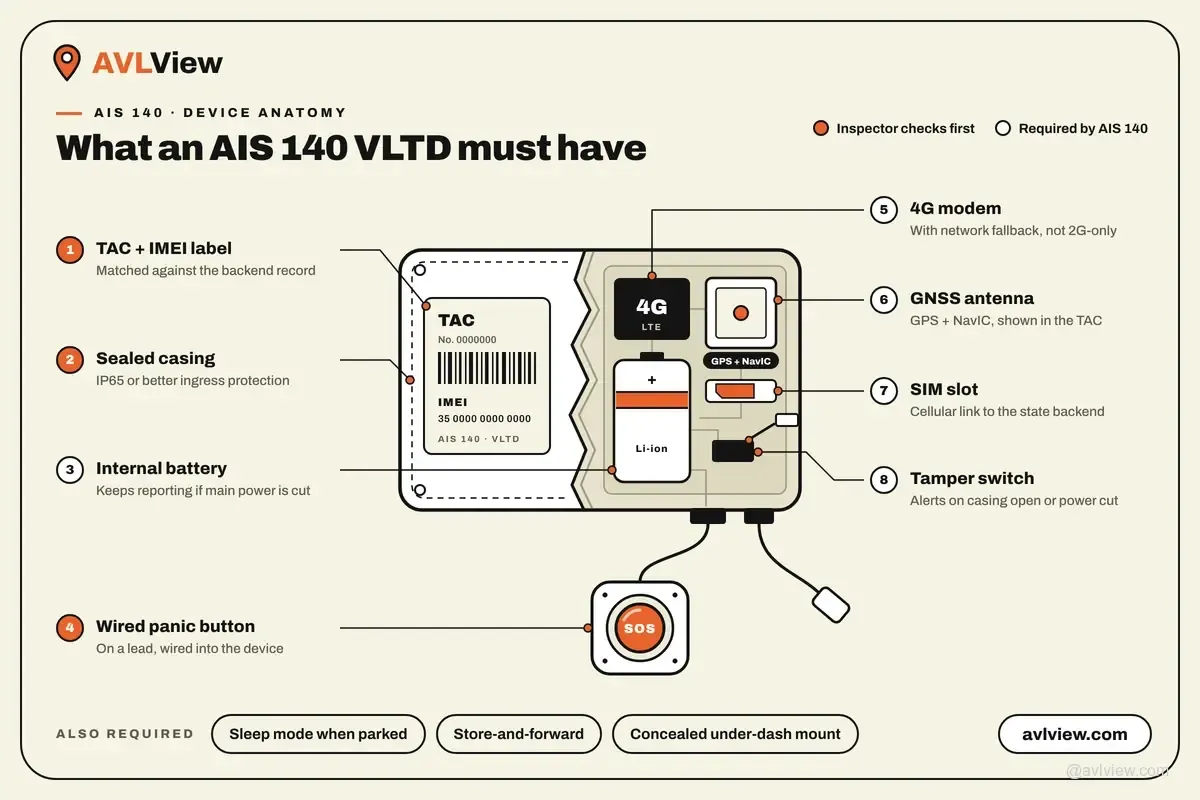
The standard is long. The parts that decide whether your device passes inspection come down to this:
- Dual-constellation GNSS with NavIC. GPS alone has not been acceptable since 1 April 2021. Ask to see NavIC in the TAC, not the brochure.
- 4G cellular with fallback. Devices on 2G-only modems are being orphaned as operators shut 2G down.
- Internal battery backup, so the device keeps reporting after someone cuts the main supply.
- Tamper detection. Opening the casing or pulling power triggers an alert.
- Sleep mode and store-and-forward. Slower reporting when parked; positions stored and sent later when there is no network.
- Ingress protection, typically IP65 or better.
- A visible IMEI label on the casing, because the inspector will match it against the backend record.
- Concealed mounting under the dashboard, out of passengers' reach. A device on a dangling cable fails inspection.
The AIS 140 panic button
The emergency button is the part of the standard that exists for passengers rather than for the transport department.
It must be a physical, hardwired button, not an app feature. When pressed, the device sends a flagged packet with the vehicle's location to the state control room and keeps sending at a higher rate until the alert is cleared from the backend. The driver cannot cancel it from the vehicle. In most states the control room is tied into the 112 emergency response system, so the alert reaches police dispatch.
For taxis and buses, one button within the driver's reach is the minimum. School buses follow the 4+1 pattern: four buttons along the passenger cabin where children can reach them, plus one for the driver, with covers or recessed mounts so a passing bag does not set them off.
School bus extras
Beyond the 4+1 buttons, most states require an over-speed buzzer inside the cabin, a tilt sensor that alerts the backend if the bus leans past a set angle, and sometimes an impact sensor. These are device features, so confirm the model has them in its TAC rather than bolting on a separate box. The Kerala guide has the full school-bus specification as one state has written it.
Certification: how to check a device is really AIS 140 compliant
Two agencies issue AIS 140 type approvals in practice: ARAI in Pune and ICAT in Manesar. MoRTH publishes a combined list of approved VLTD manufacturers, split into ARAI-approved and ICAT-approved models, last refreshed in July 2025. Other notified test agencies can issue approvals under the CMVR, but ARAI and ICAT are the two you will see on labels.
A model that passes testing receives a Type Approval Certificate, the TAC. The manufacturer then gets a login to the VLTD Maker portal on Vahan and uploads the approved model so RTOs can link devices of that model to vehicles. No TAC, no entry on Vahan, no way to link the device to your RC.
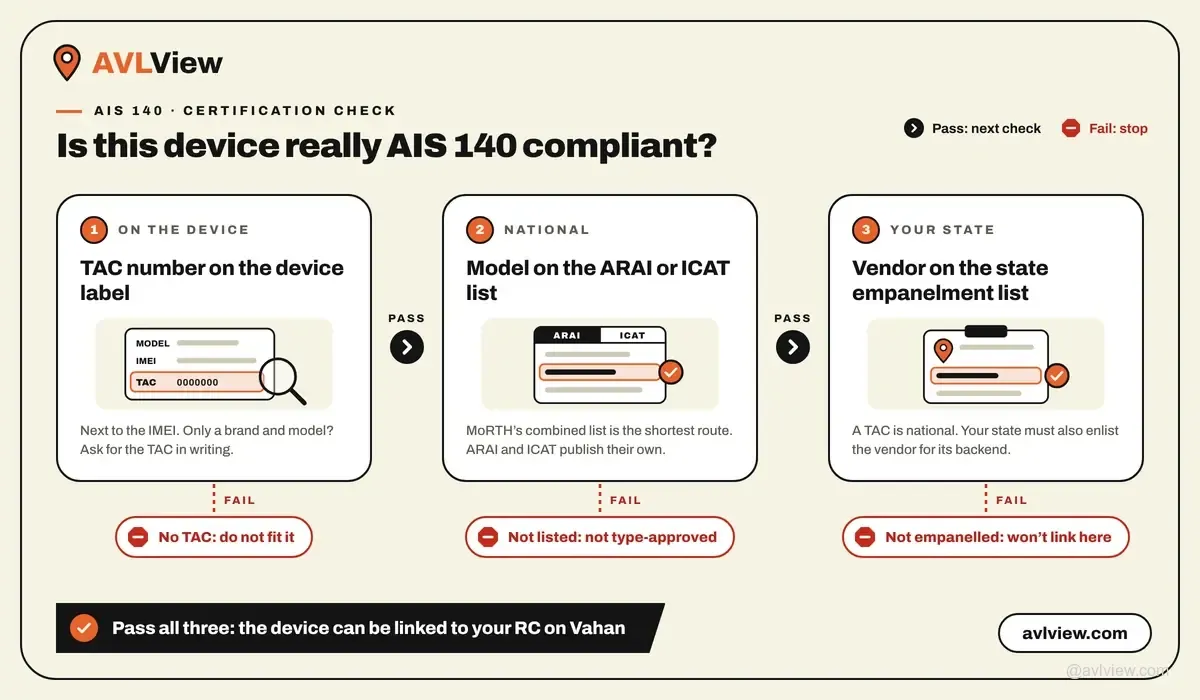
Checking a device takes three steps:
- Find the TAC on the device label. It sits next to the IMEI. If the label shows only a brand and model, ask for the TAC number in writing.
- Check the model on the agency list. MoRTH's list is the shortest route; ARAI and ICAT publish their own (links below).
- Check the vendor on your state's empanelment list. A TAC makes the device legal nationally. Your state still has to have enlisted the vendor for its backend.
Device certificate vs vehicle VLTD certificate
Most of the confusion over "AIS 140 certificate" comes from two certificates that belong to different things.
The TAC belongs to the device model. It is the manufacturer's document. You only need to see that it exists.
The fitment certificate (also called the VLTD installation certificate or VTS certificate) belongs to your vehicle. It is generated after the device is installed, linked to your RC in the state backend and Vahan, and confirmed to be sending live data. This is what the RTO asks for at fitness renewal, and the one you keep.
Since the Supreme Court's order, the paper is becoming a formality. What the RTO checks is whether Vahan shows a VLTD against your registration number with a recent position report. Your vendor can pull that record from the state backend, and several states now show it under vehicle details on the Vahan citizen portal.
Red flags
- No TAC number on the label or in the quotation
- "GPS" in the spec sheet with no mention of NavIC or IRNSS
- A 2G-only modem, or a TAC that predates the 2021 NavIC amendment
- A vendor who offers to "register later" or activate without an RTO-side entry
- A price well below the market. A certified NavIC and 4G unit has a floor cost. Far below it usually means an uncertified device, a reused IMEI, or a SIM that dies at month four.
Where to check approved AIS 140 devices
Use the type-approval lists first, then your state's list. A device needs both.
1. Type-approved models (national)
ARAI and ICAT each publish the models they have approved. ARAI's list is the more current of the two. Both show the TAC number and date and whether the model supports GPS + NavIC.
- ARAI: valid AIS 140 type approvals, as on 16 July 2026. 87 models at the last count.
- ICAT: approved vehicle tracking systems, as on 3 December 2025. Also lists expired approvals, so you can see whether a device's TAC has lapsed.
Check the CoP (conformity of production) validity column, not just the TAC. A model whose CoP has expired should not be fitted.
2. Empanelled vendors (your state)
A TAC makes a device legal nationally. Your state transport department still has to have empanelled the vendor for its backend. Each state publishes its own list, for example:
- Kerala: KMVD list of qualified AIS 140 VLTD manufacturers. See our KMVD AIS 140 guide for the Suraksha Mitr process.
- Uttarakhand: Approved manufacturers of vehicle location tracking devices
- Tripura: VLTD empanelment notification
For other states, search your transport department's website for "VLTD empanelment" or "AIS 140 enlistment".
3. How the device is linked in Vahan
MoRTH's standard operating procedure covers both new vehicles and retro-fitment: ACMA: SOP for VLT registration and activation in Vahan.
State backends and portals
The central rule tells you to fit the device. Your state tells you where the data goes. Each state or union territory runs its own tracking backend, usually with a control centre attached, and empanels vendors whose devices have been tested against it.
| State | Backend / portal | Who registers the vehicle | Notes |
|---|---|---|---|
| Kerala | Suraksha Mitr (C-DAC) | Empanelled vendor | Vidya Vahan parent app for school buses. Full Kerala guide |
| Karnataka | State VLTD backend, Transport Department | Empanelled manufacturer | Bundled price of Rs 7,599 plus GST notified for the 2023–24 window; 13 manufacturers empanelled by early 2025 |
| Tamil Nadu | State Command and Control Centre (run by C-DAC) | Enlisted manufacturer | Government order of 26 August 2025; C-DAC tests each model for 30 days against the backend |
| Maharashtra | State Registration and Fitness application, via an implementation agency | Enlisted manufacturer | Manufacturer SOP issued June 2024 |
| Odisha | vltd.odishatransport.gov.in | Approved vendor at a retro-fitment centre | Linked to the state's 112 ERSS. Older vehicles were due by 30 June 2024 |
| Goa | GA-VLTS (gavlts.goa.gov.in) | Registered vendor | Vendor application process on the portal |
| Andhra Pradesh | AP Motor Vehicle Tracking System (APMVTS) | Empanelled vendor | Empanelment run through APSAC |
| Puducherry | State VLTD backend | Enlisted manufacturer / retro-fitment centre | SOP published 2022 |
| Uttar Pradesh | District RTO, device linked in Vahan | Fitment centre, confirmed by RTO | See the UP section below |
| Delhi | Transport Department VLTD monitoring | Empanelled vendor | Enforced at fitness and permit counters |
Gujarat, Telangana, Rajasthan, Haryana, Punjab, West Bengal, Jharkhand, Assam and several north-eastern states have their own notifications too. Their portal names change often enough that we would rather you confirm with your state transport department or an empanelled vendor than trust a table on a blog. Vendor sites often name a state's bus corporation or IT department as the "backend"; it usually is not.
What ties all of it together is Vahan. Whatever the state backend is called, the device's IMEI ends up linked to your vehicle's registration record there, and that link is what every RTO has been told to check. A device that reports to a vendor's own server and nowhere else does not count.
Installation and registration, step by step
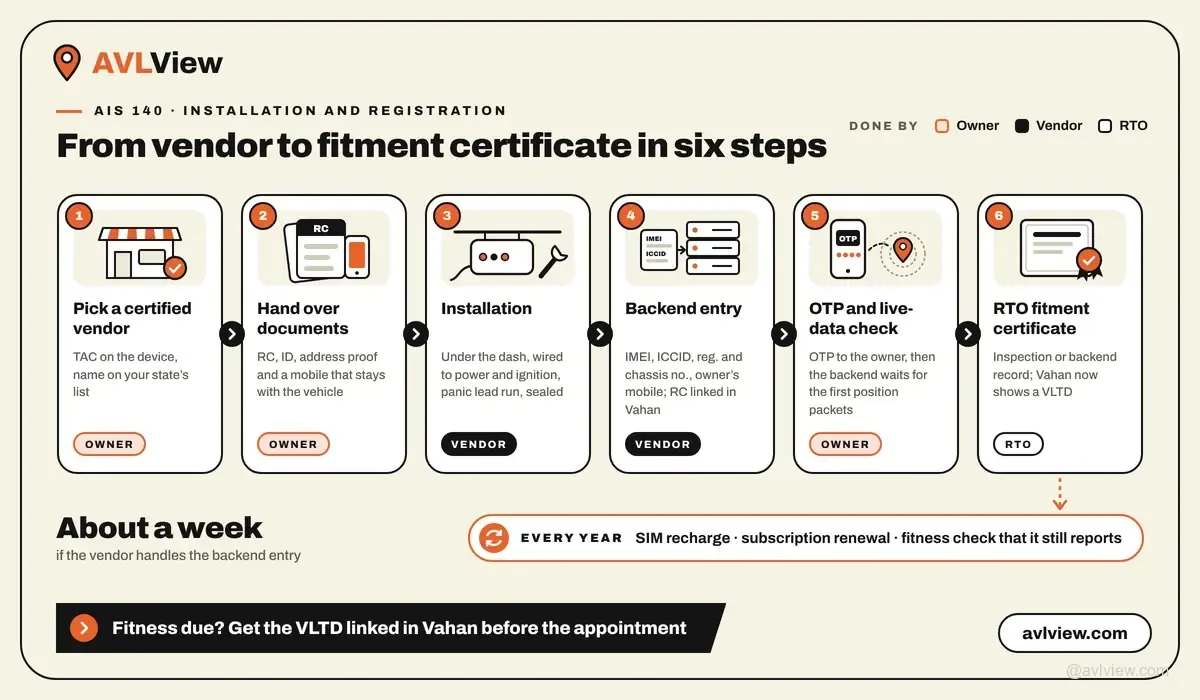
The process is similar everywhere. Only the form names change.
- Pick a vendor who is both certified and empanelled. TAC on the device, name on your state's list. Ask where the nearest service point is; you will need it when a device fails.
- Hand over the documents. Registration certificate, owner's ID and address proof, and a mobile number that stays with the vehicle. The OTP and every alert go there.
- Installation. The technician mounts the device under the dashboard, wires it to permanent power and ignition, runs the panic button lead, and seals the unit. School buses add the four cabin buttons, buzzer and tilt sensor.
- Backend registration. The vendor enters the IMEI, the SIM's ICCID, registration and chassis numbers, and the owner's mobile in the state backend. The same link is created against the RC in Vahan.
- OTP and live-data confirmation. An OTP arrives on the owner's number. The backend then waits for the first position packets before marking the device active.
- RTO inspection and fitment certificate. The RTO either inspects physically or accepts the backend's activation record. The certificate is issued against the vehicle, and Vahan now shows a VLTD.
Then it repeats, in a smaller way, every year: SIM recharge, subscription renewal, and a fitness renewal that checks the device is still reporting. Keep the renewal date somewhere other than the vendor's WhatsApp group.
A worked example. A 2017-registered 32-seater contract carriage, KA-01-AB-1234, running airport shuttles out of Bengaluru. Registered before January 2019, so never fitted at the showroom. Karnataka's window closed in November 2024 and the owner missed it. The fitness certificate comes up in January 2027. The RTO will refuse it unless Vahan shows a linked VLTD. The fix is a week's work and about Rs 9,000 all in, and it has to happen before the renewal appointment, not after.
Uttar Pradesh: VLTD installation and Vahan registration
UP has not built a separate citizen portal the way Odisha and Goa have. The transport department issued an SOP for registering VLT device makers and devices, covering public service and national permit vehicles, and individual vehicles are registered through Vahan at the district RTO.
For a UP vehicle owner the steps are:
- Choose a vendor whose model is on MoRTH's approved list and who is enlisted with the UP Transport Department.
- Get the device fitted at the vendor's fitment centre. The centre enters IMEI, SIM and vehicle details in the Vahan VLTD module.
- The RTO verifies the entry against your RC. Fitness and permit transactions in Vahan check for this link.
- Confirm the OTP on the owner's number and check live data is flowing before you leave the centre.
Two UP notes. Vehicles carrying minerals under the Directorate of Geology and Mining use a separate VTS portal (vtsdgm.up.in) with its own device mapping, in addition to the RTO requirement. And several vendors advertise a 1 January 2026 UP enforcement date; we could not find it in an official UP notification, so treat it as the date vendors started pushing harder rather than a legal cutoff. The Supreme Court's order applies to UP regardless.
What AIS 140 compliance costs
Prices vary by state, vendor and vehicle type. These are the ranges we see across India in 2026, with Kerala as the baseline and Karnataka's notified bundle as a reference point.
| Item | Typical range | Notes |
|---|---|---|
| VLTD hardware | Rs 3,500 – 12,000 | NavIC + 4G units start around Rs 4,500. School-bus kits with 4+1 buttons sit at the top |
| SIM and data | Rs 500 – 1,500 / year | M2M SIM, usually bundled |
| Installation | Rs 500 – 1,500 | Higher for school buses because of the extra wiring |
| Backend subscription | Rs 500 – 3,000 / year | Some states charge the vendor a fee that is passed through |
| First-year total | Rs 4,500 – 14,000 per vehicle | Karnataka's notified all-in price was Rs 7,599 plus GST |
| Recurring, year two on | Rs 1,000 – 4,500 per vehicle | SIM plus subscription |
For fleets of 20 or more, vendors will negotiate on hardware and subscription. Ask for the per-vehicle price with three years of subscription included, so you are not comparing a cheap device against an expensive renewal.
Penalties and fitness-certificate renewal
The Motor Vehicles Act gives enforcement officers the usual tools: fines, permit suspension for repeat offences, detention at a checkpost. Amounts differ by state. Kerala has been issuing fines in the Rs 5,000 to Rs 20,000 range.
The penalty that actually hurts is not a fine. It is the fitness certificate.
A transport vehicle without a valid fitness certificate cannot legally be on the road, and insurance claims get difficult. Since May 2026 every RTO has a Supreme Court direction to refuse that certificate, and the permit, if Vahan does not show a working VLTD. A bus on a contract that misses renewal for this reason loses far more than any challan.
The Kerala guide has the clearest example of enforcement in one state, including ANPR cameras at checkposts.
AIS 140 tracker vs an ordinary GPS tracker
The question we hear most from existing customers is whether the trackers they already have can be used for compliance. Usually not.
An ordinary tracker, even a good hardwired one, reports to the vendor's server. An AIS 140 VLTD reports to the state backend in the AIS 140 format, has a TAC, carries the emergency button, and is registered against your RC. Unless the model has a TAC and your state has empanelled the vendor, it cannot be linked in Vahan, so it does not count. Most consumer and mid-range fleet trackers were never submitted for testing.
The other direction matters more. A VLTD on its own is a compliance box. The state backend gives you nothing back: no fuel data, no driver scoring, no maintenance reminders, no report you can send a customer. Many operators end up with a certified device for the RTO and a second tracker for running the business, which means two SIMs, two subscriptions and two things to fail.
The better approach is a VLTD that reports to the state backend as required and in parallel feeds a fleet platform you actually use. Most certified models support a second server for exactly this reason.
Fitting VLTDs across a fleet? Tell us the vehicle count, the state, and whether you already have devices. We will come back with a device-and-platform quote that covers the compliance box and the fleet dashboard in one line. Get a compliance quote →
How AVLView fits
AVLView is a fleet tracking platform, not a device maker and not a government backend. We hold no ARAI or ICAT approval and do not claim one. We sit on top of certified hardware.
- Device-agnostic. AVLView works with more than 200 tracker models, including AIS 140 certified VLTDs from the ARAI and ICAT lists. If your empanelled vendor's device can report to a second server, it can report to us.
- Runs alongside the state backend. The device keeps sending compliance packets to Suraksha Mitr, the Karnataka backend, or whichever portal your state runs. AVLView receives the same stream and does the fleet work with it.
- The layer the mandate leaves out. Live vehicle tracking, fuel monitoring, driver behaviour scoring, geofencing, maintenance schedules and reports your customers can read.
- Scale. 43,000+ fleet owners run on AVLView across the Middle East, Africa and Asia, including school transport contractors and logistics fleets in India.
If you are starting from zero, the order is: certified device, state registration, then the platform. If you already have VLTDs fitted, you don’t need new hardware. We’ll send you our server address and port. Ask your vendor to add it as a second server in the device settings, and the state backend keeps receiving its data as before.
Want to see what a compliant fleet of vehicles looks like on a dashboard? Book a demo →
Last updated: October 2026. This article reflects the Central Motor Vehicles Rules, MoRTH notifications and the Supreme Court's May 2026 direction as understood at the time of writing. State requirements change often. Verify dates, vendor lists and fees with your state transport department or RTO before acting.
Frequently Asked Questions
What is the full form of AIS 140?
▼
What does VLTD stand for and what does it do?
▼
Is AIS 140 mandatory for private cars?
▼
How do I check whether a GPS device is AIS 140 certified?
▼
How much does an AIS 140 VLTD cost in India?
▼
What is the AIS 140 protocol?
▼
Join 43,000+ fleet owners on AVLView
AVLView helps you:
- Cut fuel costs by 8-15% within 90 days
- Improve driver safety and reduce accidents by 40%
- Get real-time visibility into every vehicle 24/7
- Automate reporting and save 10+ hours per week
- 30-day pilot program with no long-term commitment