KMVD AIS 140 Guidelines in Kerala
What You'll Learn
Everything Kerala fleet owners need to know about KMVD's AIS 140 mandate — compliance steps, Suraksha Mitr, penalties, costs & approved vendors.
Best for:
School Bus professionals and fleet managers
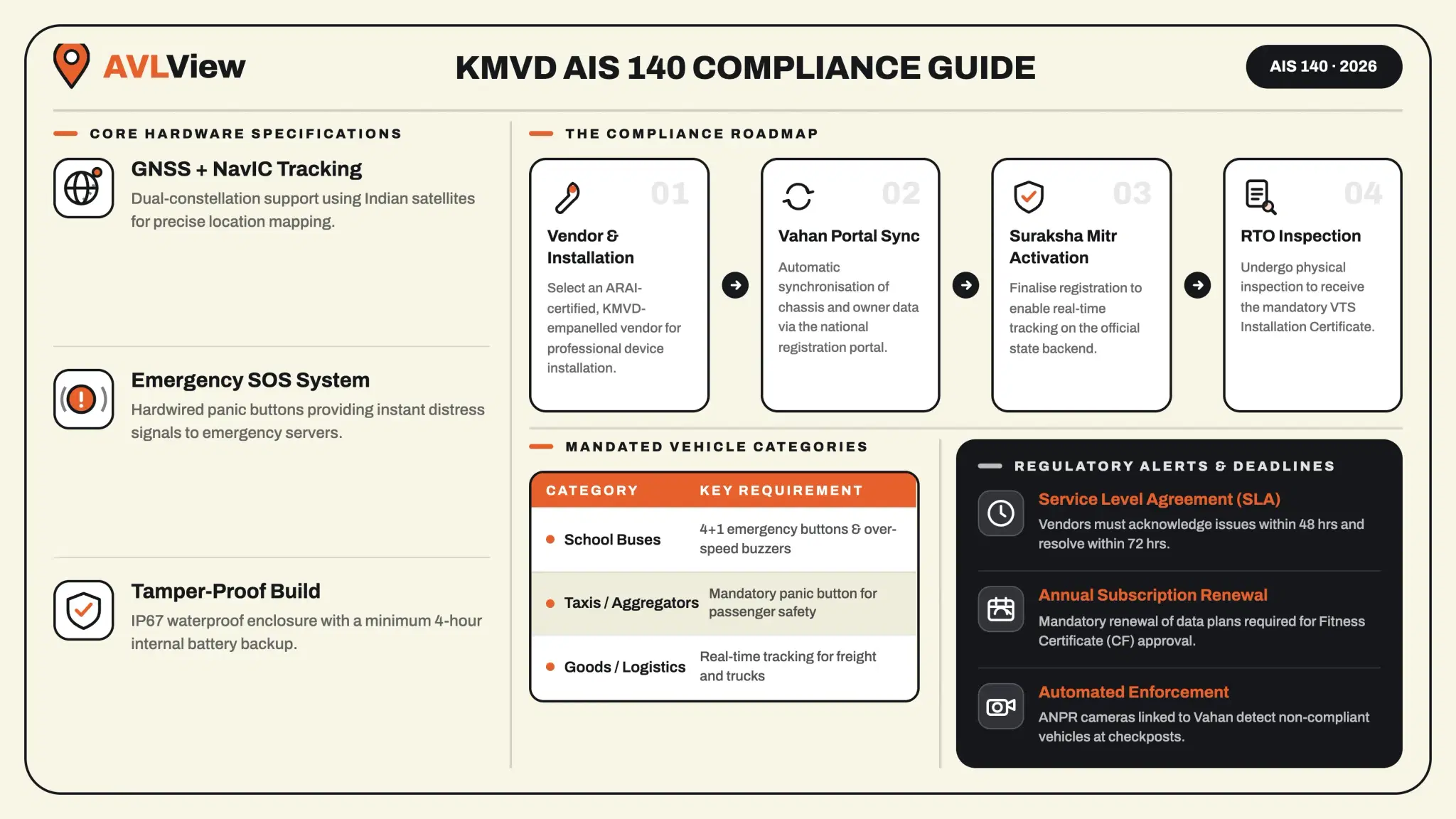
Kerala's Motor Vehicle Department (KMVD) has made it mandatory for all commercial vehicles in the state to install AIS 140-compliant GPS tracking devices. What started as a school bus safety initiative in 2018 has expanded into a full-scale vehicle tracking mandate covering every yellow-plate vehicle on Kerala's roads — from tourist buses and taxis to autorickshaws and goods carriers.
If you own or operate commercial vehicles in Kerala, this guide covers everything you need to know: which vehicles must comply, what the devices cost, how to register on Suraksha Mitr, and what happens if you don't comply.
What Is AIS 140 and Why Does Kerala Mandate It?
AIS 140 (Automotive Industry Standard 140) is a technical standard issued by the Ministry of Road Transport and Highways (MoRTH) that defines the specifications for Vehicle Location Tracking Devices (VLTDs) installed in public and commercial vehicles across India.
The standard mandates that every commercial vehicle must have a certified GPS tracking device that transmits real-time location data to a government-monitored backend server. The goal is straightforward: improve road safety, enable emergency response, and bring accountability to public transport.
Kerala was one of the early adopters. In August 2018, Transport Commissioner K. Padmakumar IPS initiated the first phase, targeting approximately 18,000 school buses across the state. The Vehicle Tracking and Monitoring System (VTMS) project, powered by C-DAC's Suraksha Mitr platform, was officially launched on October 16, 2018.
Since then, KMVD has progressively expanded the mandate through multiple phases of vendor empanelment — moving well beyond school buses to cover all categories of commercial vehicles. As of 2026, AIS 140 compliance is no longer optional for any commercial vehicle registered in Kerala.
Which Vehicles Must Comply in Kerala?
The simple rule: if your vehicle has a yellow number plate, it must have an AIS 140-compliant VLTD installed and registered on Suraksha Mitr.
Here's the full list of vehicle categories covered under KMVD's mandate:
- School buses and educational institution vehicles — the first category mandated (Phase 1, 2018)
- Stage carriages — KSRTC buses, private stage carriage operators
- Contract carriages — tourist buses, charter vehicles, private hire buses
- Taxis — including app-based aggregators (Ola, Uber)
- Autorickshaws — three-wheeler commercial passenger vehicles
- Goods vehicles — trucks, freight carriers, logistics vehicles
- Ambulances — emergency medical transport
- Employee transport vehicles — corporate and IT sector shuttle services
Private vehicles (white number plates) are not required to comply with AIS 140.
AIS 140 Device Requirements (2026 Standards)
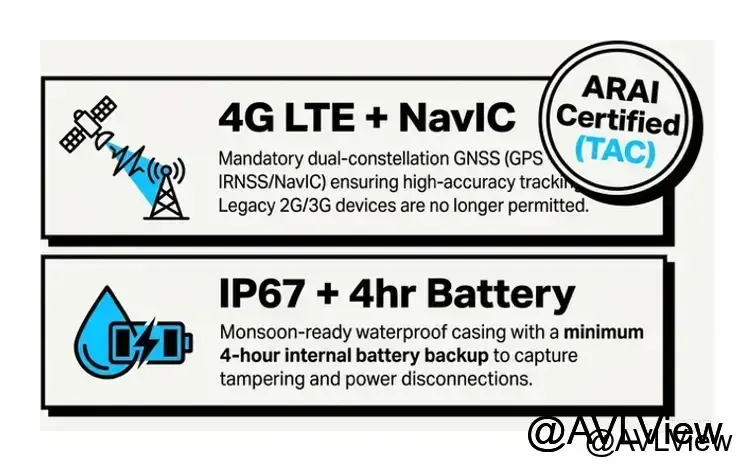
Not just any GPS tracker will do. AIS 140 devices must meet specific technical standards and carry ARAI (Automotive Research Association of India) certification. Here's what a compliant device must include:
Mandatory Technical Specifications
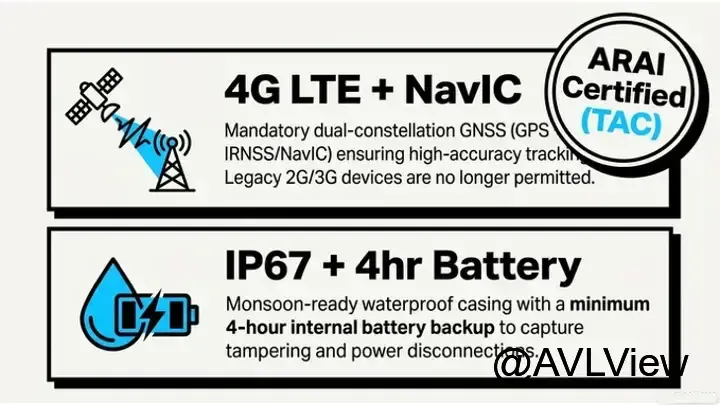
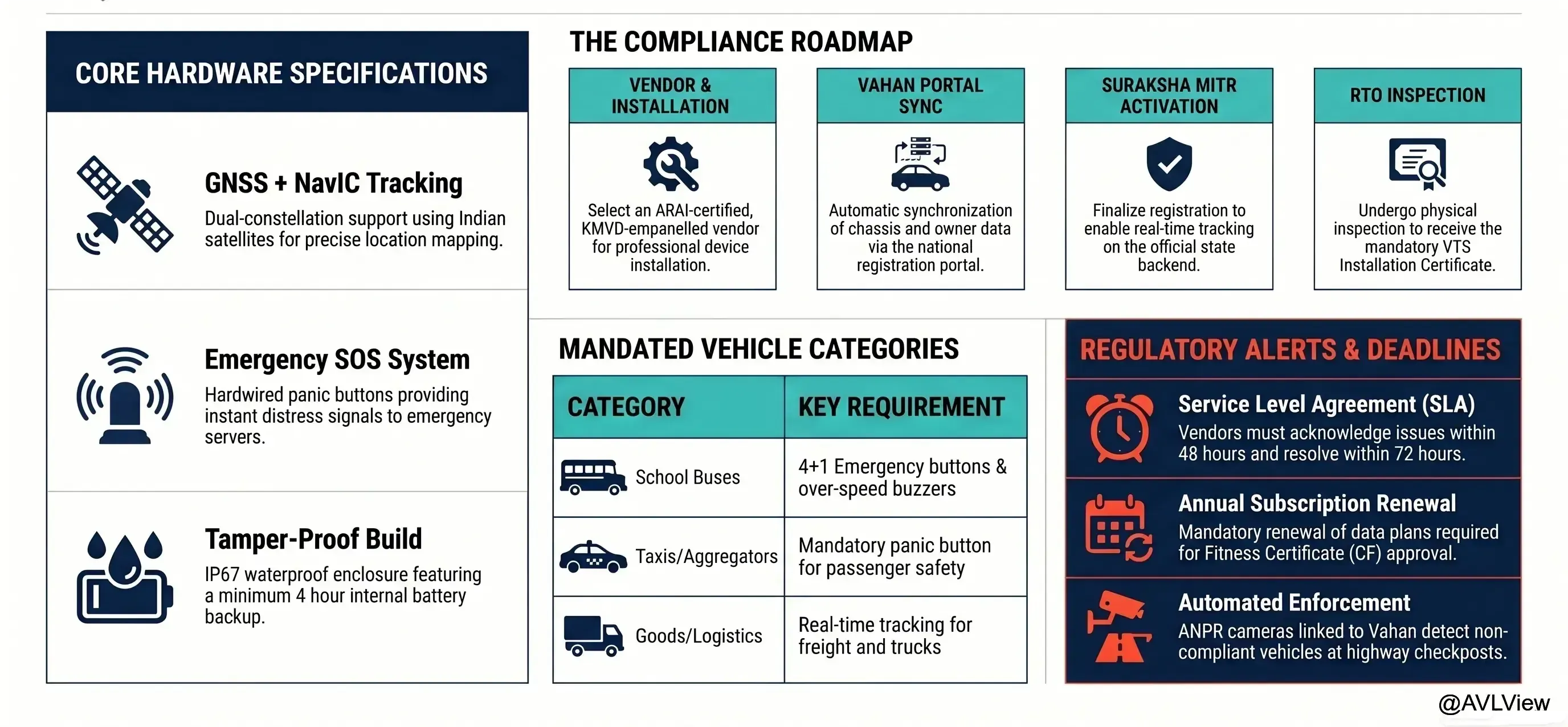
- Dual-constellation GNSS: The device must support both GPS and NavIC (IRNSS — India's indigenous satellite navigation system). NavIC support has been mandatory since April 1, 2021, as part of India's push to use its own navigation infrastructure. ISRO's expanded NavIC constellation, including the NVS-1 and NVS-2 satellites, has significantly improved positioning accuracy.
- Physical panic/SOS button: A hardwired emergency button accessible to the driver or passengers. When pressed, it sends an immediate distress signal with the vehicle's GPS coordinates to the Suraksha Mitr backend and designated emergency contacts.
- 4G connectivity: Devices must support 4G LTE for reliable, real-time data transmission. Older 2G/3G-only devices are no longer adequate as telecom operators phase out legacy networks.
- IP67 waterproof rating: The device must withstand dust and temporary water submersion — essential for Kerala's monsoon conditions.
- Minimum 4-hour battery backup: The device must continue transmitting even if the vehicle's power supply is disconnected, ensuring tamper scenarios are captured.
- Tamper detection: The device must detect and alert if someone attempts to remove, disconnect, or interfere with it.
- ARAI certification: Every device must carry a valid Type Approval Certificate (TAC) number issued by ARAI after testing at their Pune facility. Uncertified devices will not be accepted during RTO inspections.
School Bus Specific Requirements
School buses have additional requirements beyond the standard AIS 140 specifications:
- 4+1 emergency buttons: Four panic buttons for students (distributed across the bus interior) and one for the driver
- Over-speed buzzer: Audible alarm that triggers when the bus exceeds the prescribed speed limit
- Tilt alert: Sensor that detects abnormal vehicle tilting, indicating potential rollover
- Impact alert (recommended): Detects sudden deceleration or collision events
The VTU must be mounted under the dashboard or in a location that is not easily accessible or exposed to passengers, as per Section 5.3 of the AIS 140 guidelines. The IMEI number must be visibly displayed on the device casing for quick identification during inspections.
Suraksha Mitr: Kerala's Vehicle Tracking Backend
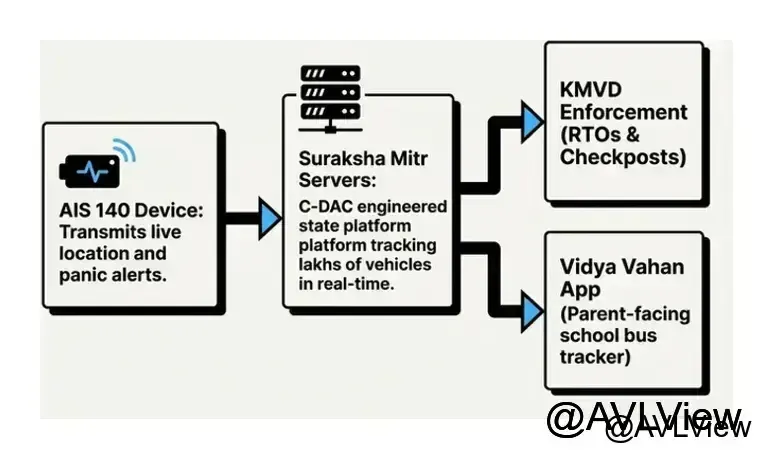
Suraksha Mitr is the GPS-based vehicle tracking and monitoring platform developed by C-DAC (Centre for Development of Advanced Computing) for Kerala's Motor Vehicle Department. It serves as the state's official AIS 140 backend — every compliant device installed in Kerala must transmit data to this platform.
What Suraksha Mitr Does
- Receives and processes real-time GPS data from all registered commercial vehicles
- Monitors speed violations, route deviations, and unauthorized stops
- Processes panic button alerts and routes them to emergency responders
- Generates compliance reports for RTOs and enforcement officers
- Integrates with the national VAHAN portal for cross-referencing vehicle registration data
The platform is designed to handle lakhs of vehicles simultaneously and can be scaled further as more vehicle categories come under the mandate.
Vidya Vahan: Parent-Facing School Bus Tracking
Built on top of Suraksha Mitr, the Vidya Vahan mobile app is KMVD's dedicated solution for school bus tracking. The app allows parents to:
- Track their child's school bus in real-time
- Monitor bus speed and receive over-speed alerts
- Get emergency notifications
- Directly call the bus driver or helper
As of 2024, approximately 31,321 school vehicles have been fitted with GPS systems, though only about 20,269 are actively registered on Vidya Vahan — roughly 60% adoption. KMVD is actively pushing schools to register all parents on the app and has made Vidya Vahan integration mandatory for school vehicles.
The app is free to download on Android. Parents need to contact their school to register their mobile number before they can access tracking. For technical support, KMVD provides a toll-free helpline at 1800 5997099.
Already managing a fleet in Kerala? AVLView works alongside Suraksha Mitr — your vehicles stay government-compliant while you get a full fleet management dashboard with fuel monitoring, driver scoring, and automated reports. See how it works →
Step-by-Step: How to Get AIS 140 Compliant in Kerala
Step 1: Choose an ARAI-Certified, KMVD-Empanelled Vendor
Select a VLTD vendor that is both ARAI-certified (nationally) and empanelled by KMVD (state-level). The empanelled vendor list is available on the Kerala MVD website. Verify the vendor's ARAI TAC (Type Approval Certificate) number — every certified device has a unique approval number on its label.
Step 2: Submit Your Documents
Provide the following to your chosen vendor: - Vehicle Registration Certificate (RC) copy - KYC documents (owner identification) - Active mobile number for OTP verification and alerts
Step 3: Device Installation
A qualified field engineer from the vendor installs the VLTD in your vehicle. For school buses, this includes mounting the device under the dashboard, wiring the 4+1 panic buttons, and configuring the over-speed buzzer and tilt sensors. For other commercial vehicles, the standard installation includes the device and driver panic button.
Step 4: Suraksha Mitr Registration
The vendor registers your vehicle on the Suraksha Mitr portal by feeding in: - Vehicle registration details - Device IMEI number - Owner's mobile number - Vehicle category and operating region
Step 5: OTP Verification and Location Confirmation
You'll receive an OTP on your registered mobile number. Once verified, the system confirms the vehicle's GPS location is transmitting correctly to the Suraksha Mitr backend.
Step 6: RTO Physical Inspection
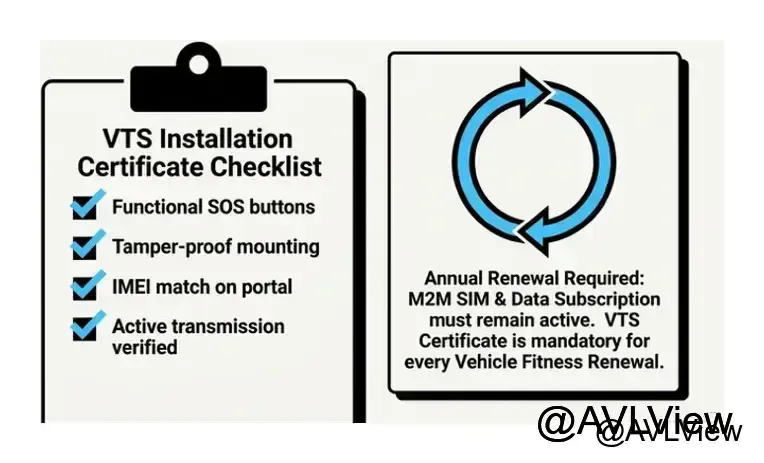
Visit your Regional Transport Office (RTO) for a physical inspection. The RTO officer will verify: - Device is properly installed and tamper-proof - Panic button(s) are functional and accessible - IMEI number on the device matches the Suraksha Mitr registration - Device is actively transmitting to the backend
Step 7: GPS Installation Certificate
Upon successful inspection, the RTO issues a VTS (Vehicle Tracking System) Installation Certificate. Keep this document — you will need it for every fitness certificate renewal going forward.
Step 8: Annual Renewal
AIS 140 compliance is not a one-time activity. You must: - Renew your VLTD data subscription annually - Ensure the device remains functional and transmitting - Submit the VTS Installation Certificate during each fitness renewal - Address any device malfunctions within 72 hours (vendor SLA requirement)
Vendors are required to maintain service points across Kerala — currently in Thiruvananthapuram, Ernakulam, Thrissur, and Kozhikode — and must respond to service requests within 48 hours.
Penalties for Non-Compliance
KMVD and RTOs across Kerala are actively enforcing AIS 140 compliance. The consequences of non-compliance are significant and getting stricter.
What You Face Without a Compliant Device
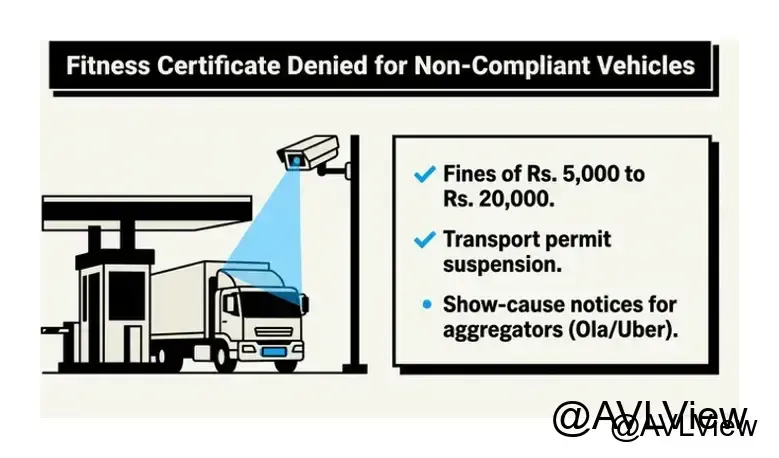
- Fitness certificate renewal denied: RTOs will not renew your vehicle's fitness certificate without a valid VTS Installation Certificate. No fitness certificate means your vehicle cannot legally operate.
- Monetary fines: Penalties range from Rs. 5,000 to Rs. 20,000 or more, depending on the vehicle category and the nature of the violation.
- Transport permit suspension or cancellation: Repeat non-compliance or refusal to install a VLTD can result in your operating permit being suspended or permanently cancelled.
- Vehicle detention at checkposts: Enforcement officers can detain non-compliant vehicles at checkposts. With Kerala MVD implementing virtual border checkposts using ANPR cameras linked to the VAHAN database, automated detection of non-compliant vehicles is now possible.
- Show-cause notices for aggregators: Taxi aggregators like Ola and Uber face show-cause notices if their fleet vehicles are found non-compliant.
National Deadline
MoRTH set October 31, 2025 as the compliance deadline for all commercial vehicles registered before January 2025. Vehicles registered after January 2025 must have AIS 140 devices installed at the time of registration. Enforcement drives have intensified across India, with Kerala among the states actively linking compliance to fitness certificate renewals.
Real-Time Enforcement
Kerala MVD is deploying ANPR (Automatic Number Plate Recognition) cameras integrated with the VAHAN database at toll booths and checkposts across the state. This means enforcement is increasingly automated — officers can verify your compliance status in real time without stopping your vehicle.
Costs: What to Budget
AIS 140 compliance involves both upfront and recurring costs. Here's what Kerala fleet owners should expect in 2026:
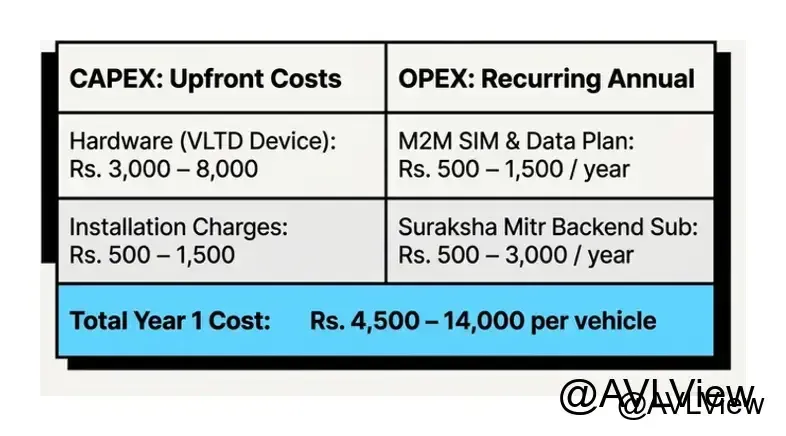
| Cost Component | Estimated Range |
|---|---|
| VLTD hardware (device) | Rs. 3,000 – 8,000 |
| M2M SIM card and data plan | Rs. 500 – 1,500/year |
| Installation charges | Rs. 500 – 1,500 |
| Backend subscription (Suraksha Mitr) | Rs. 500 – 3,000/year |
| Total first-year cost | Rs. 4,500 – 14,000 per vehicle |
The wide range depends on the device model, vendor, and whether you need additional features like school bus panic buttons or tilt sensors. Annual recurring costs (SIM + subscription) typically run Rs. 1,000 – 4,500 per vehicle.
For fleet owners with multiple vehicles, most vendors offer volume pricing. It's worth comparing quotes from at least 2–3 empanelled vendors before committing.
How to Choose an Approved Vendor in Kerala
Not all AIS 140 vendors are equal. Here's what to check before selecting one:
Must-Have Qualifications
- ARAI certification: Verify the device's TAC number on ARAI's official list. The latest approved manufacturer list (updated January 2026) is available on the ARAI website.
- KMVD empanelment: The vendor must appear on Kerala MVD's empanelled list. Check at mvd.kerala.gov.in.
- NavIC support: Non-negotiable since April 2021. Confirm the device supports dual-constellation (GPS + NavIC).
- 4G connectivity: Essential as 2G/3G networks are being phased out.
Questions to Ask Your Vendor
- What is your service response time? (KMVD requires 48-hour response, 72-hour resolution)
- Where are your nearest service centres in Kerala?
- What does the annual subscription cover? (data, backend access, support)
- Do you handle the Suraksha Mitr registration and RTO coordination?
- What is the device warranty period?
- Can you provide a dashboard for fleet-level monitoring beyond basic compliance?
Red Flags to Avoid
- Vendors offering devices without ARAI TAC numbers
- GPS-only devices without NavIC support
- 2G-only connectivity
- No local service centres in Kerala
- Unclear or missing SLA commitments
How AVLView Helps Kerala Fleet Owners Stay Compliant
AVLView is a GPS fleet tracking platform trusted by 43,000+ fleet owners across the Middle East, Africa, and Asia — including fleet operators in Kerala.
Here's how AVLView supports AIS 140 compliance in Kerala:
- AIS 140 compliant: AVLView supports ARAI-certified, NavIC-enabled VLTDs that meet all current AIS 140 requirements.
- Suraksha Mitr integration: Devices work with Kerala's Suraksha Mitr backend for regulatory compliance while giving fleet owners access to AVLView's own advanced tracking dashboard.
- Beyond compliance: While AIS 140 gives you a panic button and basic location tracking, AVLView delivers a full fleet management suite — real-time tracking, fuel monitoring, driver behaviour scoring, geofencing, route optimization, and automated reports.
- 200+ device compatibility: AVLView is device-agnostic, supporting over 200 GPS hardware models. If you already have installed devices, there's a good chance AVLView can work with them.
- Cloud-based platform: No local server infrastructure needed. Access your fleet dashboard from any browser or mobile device.
- Local support: Dedicated support for Kerala-based fleet operators with regional knowledge of KMVD requirements and RTO processes.
Whether you're managing 5 school buses or 500 freight vehicles, AVLView helps you meet KMVD's mandate while getting real operational value from your GPS investment — not just a compliance checkbox.
Frequently Asked Questions
Is AIS 140 mandatory for private vehicles in Kerala?
No. AIS 140 applies only to commercial vehicles — those with yellow number plates. Private vehicles (white plates) are not covered under this mandate.
Can I install any GPS tracker to comply with AIS 140?
No. The device must be ARAI-certified with a valid Type Approval Certificate (TAC) number and must support both GPS and NavIC satellite systems. Additionally, in Kerala, the vendor must be empanelled by KMVD.
What is NavIC and why is it required?
NavIC (Navigation with Indian Constellation), also known as IRNSS, is India's indigenous regional satellite navigation system developed by ISRO. The government mandated NavIC support in all AIS 140 devices from April 1, 2021, to reduce dependence on foreign satellite systems and leverage India's own navigation infrastructure.
What happens if my tracking device stops transmitting?
If your device goes offline, the Suraksha Mitr backend will flag it. While there's no immediate penalty for brief outages, a non-functional device at the time of your fitness certificate renewal will result in the renewal being denied. You should contact your vendor immediately — they are required to respond within 48 hours and resolve issues within 72 hours.
How often does the device transmit location data?
AIS 140 mandates real-time data transmission at defined intervals (typically every few seconds when the vehicle is in motion). The exact interval is configured per the AIS 140 specification and cannot be modified by the vehicle owner.
Do I need to renew my AIS 140 subscription every year?
Yes. The M2M SIM data plan and backend subscription require annual renewal. If the subscription lapses, the device stops transmitting, and your vehicle will be flagged as non-compliant at the next fitness check.
What is Vidya Vahan?
Vidya Vahan is a mobile app built on the Suraksha Mitr platform, specifically for parents to track school buses in real-time. It's free to download, but parents must register their mobile number through their school. KMVD has made it mandatory for all school vehicles.
How much does AIS 140 compliance cost per vehicle?
First-year costs range from Rs. 4,500 to Rs. 14,000 per vehicle, including the device, installation, SIM, and backend subscription. Annual recurring costs after the first year are typically Rs. 1,000 to Rs. 4,500.
Last updated: June 2026. This article reflects the latest KMVD guidelines and national AIS 140 enforcement rules as of the publication date. Regulations may change — always verify with your local RTO or the Kerala MVD website for the most current requirements.
Ready to Transform Your Fleet Operations?
See how AVLView helps fleet managers like you cut costs, improve safety, and boost efficiency with real-time GPS tracking.
Join 43,000+ Fleet Owners Who Trust AVLView
AVLView helps you:
- Cut fuel costs by 8-15% within 90 days
- Improve driver safety and reduce accidents by 40%
- Get real-time visibility into every vehicle 24/7
- Automate reporting and save 10+ hours per week
- 30-day pilot program with no long-term commitment