How to Start a GPS Tracking Business with White-Label Software

What You'll Learn
A complete roadmap to launching a GPS tracking business: hardware sourcing, white-label software, pricing and winning your first 10 fleet customers.
Best for:
White-label / Partners professionals and fleet managers
Starting a GPS tracking business takes four things: a hardware supplier, a tracking platform, a pricing model, and your first ten fleet customers. The old fifth requirement — spending years and six figures building the software — is gone: white-label platforms let you launch under your own brand in weeks.
It remains one of the most attractive small-business models in B2B tech: recurring revenue, sticky customers, and demand pushed by fuel prices, theft and regulation in exactly the regions where fleets are digitising fastest — the Gulf, Africa and South Asia.
This is the complete roadmap: the business model and its maths, the build-vs-white-label decision, six launch steps, and the mistakes that sink first-year resellers.
The Business Model: Why Recurring Revenue Changes Everything
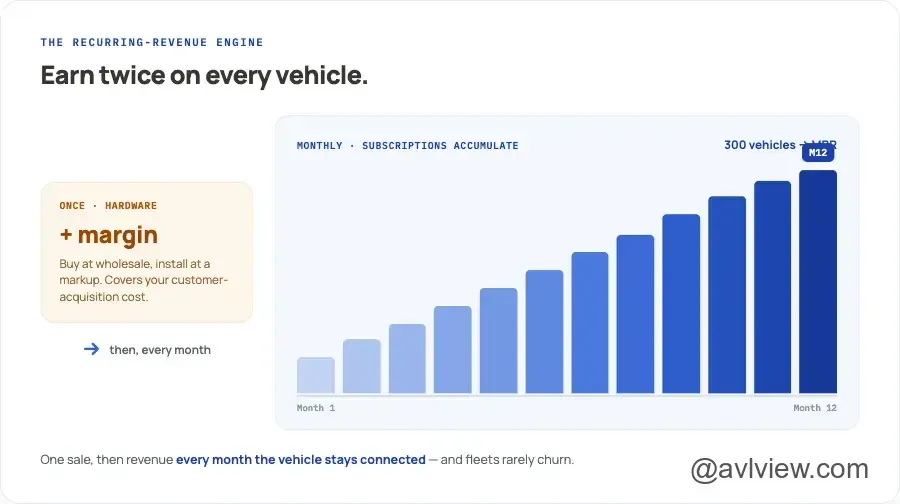
A GPS tracking business earns twice on every vehicle.
Once on the hardware: you buy trackers at wholesale and install them at a margin. This covers your customer-acquisition cost.
Every month on the subscription: each connected vehicle pays a monthly fee for the platform, SIM data and your support. This is the business — because it accumulates.
Run the maths on a modest first year: sign 15 small fleets averaging 20 vehicles each, and you're billing 300 vehicles monthly. At typical regional pricing, that's meaningful recurring income from a two-person operation — and unlike hardware sales, it doesn't reset to zero each January. Fleet customers rarely churn: switching trackers across 20 vehicles is painful, so good service compounds year after year.
Build Your Own Platform vs White-Label: The Honest Comparison
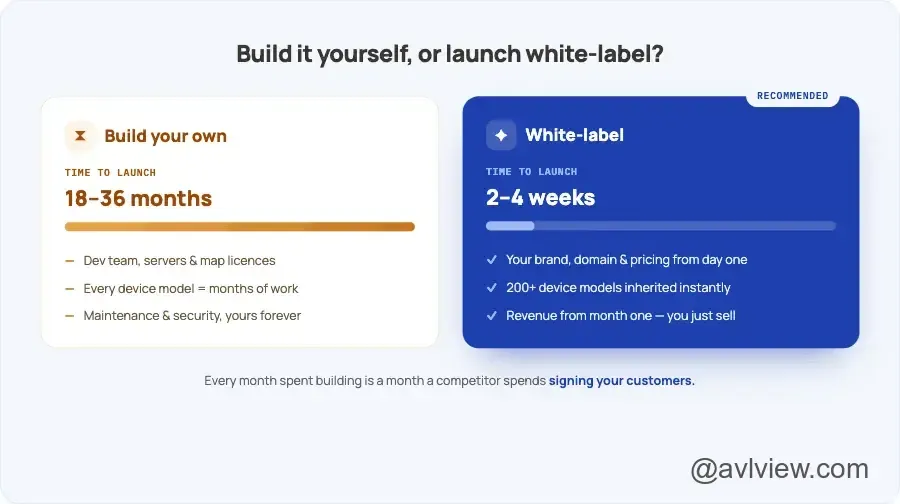
| Build your own | White-label | |
|---|---|---|
| Time to launch | 18–36 months | 2–4 weeks |
| Upfront cost | Development team, servers, map licences | Modest setup, pay per vehicle |
| Your brand | Yes | Yes — your logo, domain and pricing |
| Device support | Every model = months of integration work | Inherited — 200+ models from day one |
| Maintenance | Yours forever: servers, updates, security | Platform provider's problem |
| What you focus on | Software engineering | Selling and serving customers |
Building makes sense for exactly one kind of founder: one whose actual product is software. If your plan is to sell tracking to fleets in your city, every month spent building is a month your competitors spend signing your customers.
A white-label GPS tracking platform gives you the finished product — live tracking, alerts, reports, mobile apps — wearing your brand. Your customers see your logo, your domain, your prices. They never know (or need to know) whose engine runs underneath.
The 6-Step Roadmap to Launch
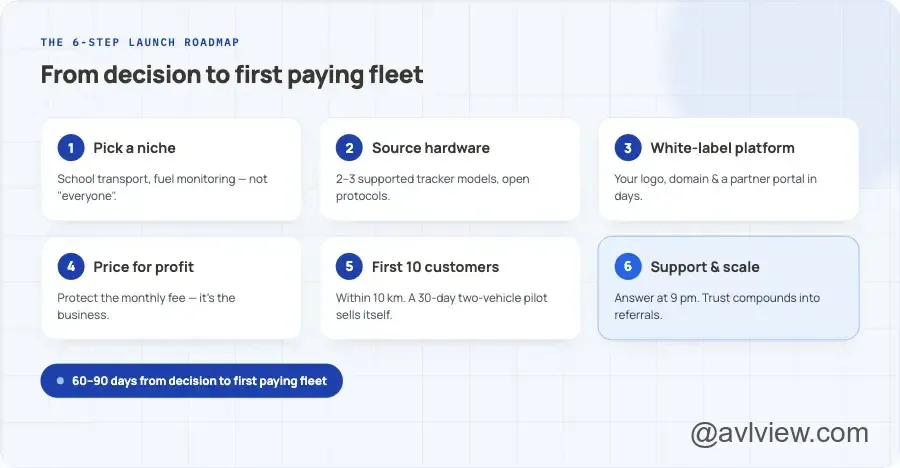
Step 1: Pick a Niche Before You Pick Anything Else
"GPS tracking for everyone" is a price war. "GPS tracking for school transport" or "fuel monitoring for construction fleets" is a business. A niche tells you which hardware to stock, what to charge, and exactly who to call first. Study what fleets in your city struggle with — safety compliance, fuel theft, delivery ETAs — and lead with that.
Step 2: Source Your Hardware
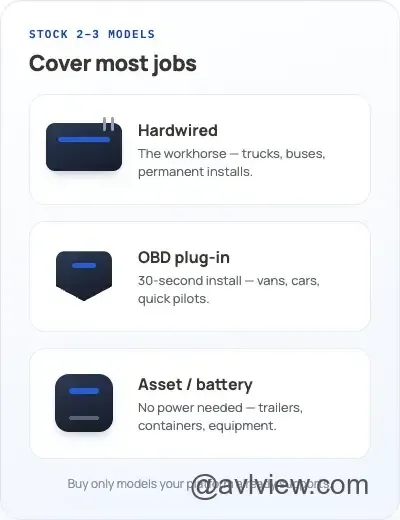
You'll need two or three tracker models to cover most jobs — a hardwired workhorse, an OBD plug-in for quick installs, and optionally a battery asset tracker. Our guide to the types of GPS tracking devices covers exactly which type fits which vehicle.
Two sourcing rules: buy only from established manufacturers your platform already supports (check the supported device list before ordering), and confirm local certification requirements — some markets mandate approved devices for commercial vehicles.
Step 3: Set Up Your White-Label Platform
This is days, not months: your logo, your domain, your colour scheme on the web dashboard and mobile apps. A proper white-label setup also gives you a partner portal — one screen where you manage all your client accounts, provision devices, and control what each customer sees and pays.
Step 4: Price for Recurring Profit
The classic first-year mistake is underpricing the monthly fee to win the hardware sale. The hardware margin is one-time; the subscription is forever — protect it. Bundle your support and installation into the monthly price, keep a healthy margin over your platform cost, and offer tiers: basic tracking, then full telematics with fuel and driver behaviour as the upsell.
Step 5: Win Your First 10 Customers
Your first customers are within ten kilometres of you: the distributor whose vans you see daily, the school with 15 buses, the construction contractor losing diesel. Offer a two-vehicle pilot for 30 days — in our experience the fuel and idling data sells the remaining fleet by itself. Ask every satisfied owner for one referral; fleet communities in every city are small and word travels.
Step 6: Support Well, Then Scale
Tracking is a trust business: when a fleet owner calls about a vehicle at 9 pm, someone must answer. Great local support is precisely how a two-person reseller beats a global brand in their own city — you're there, the big vendor isn't. As you grow, partner resources — training material, sales collateral, spec sheets — keep your operation looking bigger than its headcount.
Want to see the platform your customers would get? Explore the white-label platform →
A Realistic Picture: Year One in Kampala
A composite from partners we've onboarded across East Africa: a two-person operation launches with a school-transport niche, two tracker models and a white-labelled platform.
Months 1–3 go to the pilot grind — three schools, 40 buses, parents' peace-of-mind as the pitch. By month 6, referrals from school administrators bring in the first logistics customers, because the person who runs the school buses knows the person who runs the delivery vans. Closing year one: ~400 vehicles billing monthly, support still handled from two phones, and the hardware margin from Q4 alone funding the first hire.
No venture capital, no code written. Niche, service, referrals — repeated.
Four Mistakes That Sink New Trackers Businesses
- Competing on price alone. There's always someone cheaper. Compete on niche expertise and 9 pm phone answers instead.
- Buying locked hardware. Trackers that only speak to one vendor's platform make you the hostage. Stock devices with open protocols that any serious platform supports.
- Skipping the niche. Generalists get compared on price (see mistake 1). Specialists get referred.
- Treating support as a cost. In this business, support is the product. The subscription your customer pays every month is for the certainty someone answers.
The Bottom Line
The GPS tracking business rewards exactly what a small local operator has: proximity, hustle and trust. The software — once the barrier that kept this market to big players — is now the easy part.
AVLView's white-label programme powers reseller businesses across the Middle East, Africa and Asia on the same platform trusted by 43,000+ fleet owners: your brand, 200+ supported devices, client management portal, and a partner team that's done this launch dozens of times.
Tell us your market and we'll walk you through the numbers, the setup and the first-90-days plan. Talk to the partner team →
Frequently Asked Questions
How much does it cost to start a GPS tracking business?
Far less than most tech businesses. Your main upfront costs are an initial hardware inventory (often 20–50 trackers), white-label platform setup, and basic marketing. Because the platform is subscription-based per vehicle, software costs scale with revenue instead of preceding it. Many resellers launch from a home office with no staff.
Is a GPS tracking business profitable?
The model is structurally attractive: hardware margin covers acquisition, and monthly subscriptions accumulate — 300 connected vehicles means 300 recurring payments with very low churn, since switching trackers across a fleet is painful. Profitability comes down to protecting your monthly price and keeping customers well-supported.
Do I need technical skills to start?
You need installation skills (learnable in days, or subcontractable to auto electricians) and platform administration, which a white-label provider trains you on. You do not need to write software — the platform, apps, servers and device integrations are the provider's job.
Should I build my own tracking platform instead?
Only if software is your actual product and you have years of runway. Building means 18+ months of development before your first dollar, plus permanent server, mapping and integration costs. White-label gets you to market in weeks with a mature product — and lets you spend that energy on customers.
How does AVLView's white-label programme work?
You get the AVLView platform under your own brand — your logo, domain and pricing — plus a partner portal to manage all your client accounts, support for 200+ device models so you choose your own hardware, and training and sales resources. You own the customer relationship and set your own margins.
Last updated: July 2026.
Ready to Transform Your Fleet Operations?
See how AVLView helps fleet managers like you cut costs, improve safety, and boost efficiency with real-time GPS tracking.
Join 43,000+ Fleet Owners Who Trust AVLView
AVLView helps you:
- Cut fuel costs by 8-15% within 90 days
- Improve driver safety and reduce accidents by 40%
- Get real-time visibility into every vehicle 24/7
- Automate reporting and save 10+ hours per week
- 30-day pilot program with no long-term commitment